30 Eylül 2011 Cuma
2011 Acura TSX Tech
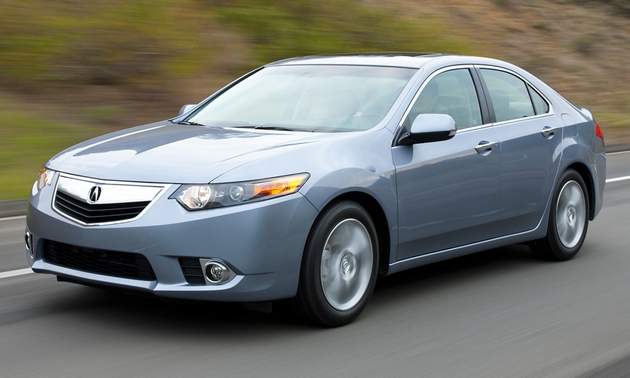
This 2011 Acura TSX Tech is Exhibit A on how small-displacement engines can still add up to a lot of fun. The 2.4-liter four-banger under the hood makes just 201 hp, but because of a terrific short-throw six-speed manual, a great chassis with a (sometimes overly) firm suspension and direct steering, you maximize every last pony at your disposal. Really, if I could change one thing about this car, it would be to have that great powerplant drive the rear wheels instead of the front ones.
The overall balance of this Acura is terrific, and the handling is as good as any front-driver on the market. This is a fun car to grab a lower gear, toss into a corner and put the power down, look for the exit and then hopefully, another corner just around the bend. This is one of those cars that rewards aggressive driving, letting you know at all times exactly where you are at on the road.
Combine all of these great handling attributes with what is arguably one of the best sound systems on wheels, and you have a rather compelling overall package. As a daily driver, you could certainly do a whole lot worse for your $35,000.
You're right, Roger. You could do a whole lot worse for a daily driver. In fact, if I was looking for a daily driver of my own, the Acura TSX would be it. It's no secret that I'm a Honda/Acura fan (though, it's becoming more difficult with each passing year) and I love this K-series engine and six-speed manual drivetrain combination. The shifter is precise and clutch take-up is tuned to my liking in the middle of the pedal stroke.
The 2.4-liter four-cylinder is smooth and revs effortlessly to its 7,000-rpm redline. As is standard procedure with these high-strung Honda engines, you need to keep the revs up to stay in the power and that's something I enjoy doing. This coming from someone who autocrossed my brother's Integra Type R (8,400-rpm redline) a lot before and currently has a S2000 CR (8,000-rpm redline) in the garage.
Besides the drivetrain, the chassis tuning is also something I like a lot. The steering is hypersensitive and will catch people by surprise in the beginning, but you get acclimated to it easily and will end up enjoying it when placing the car wherever you want, whenever you want is so easy. The suspension is stiffer, while not punishing you during normal commutes. The overall result is a car that feels eager and light on its feet even weighing in at 3,400 pounds.
As much as I like this car, I'm not under the illusion that the blade/beak front grille looks good. I will say that the TSX is probably the best integration of the hideous front end, though. The rest of the exterior is clean and sharp-looking with the subtle wheel arches.
Inside, the cabin is great with supportive and comfortable front bucket seats. It's easy to find a good seating position, and the minefield of buttons on the center stack to control radio/climate/navigation functions is overwhelming at first glance but is easily picked up. Would you rather have an iDrive-like system, a touch screen or a bunch of buttons? I'll take buttons every time.
On our Technology package model, the ELS audio system sounds great and is one of my favorite setups. The navigation system is also intuitive, and the rearview camera projects a nice, clear image on the center screen.
My best piece of advice to those shopping a TSX is to resist going with the more powerful V6 model and get the four-cylinder with the six-speed manual. However, if you want the technology stuff with that drivetrain, you best run to the dealership now to find a leftover 2011 model. Acura won't be offering the Technology package with the I4 and manual for 2012, which I think is a shame. Instead, it will only be offered on the more performance-oriented Special Edition models, which I do look forward to driving.
2011 Acura TSX Tech
Base Price: $35,595
As-Tested Price: $35,595
Drivetrain: 2.4-liter I4; FWD, six-speed manual
Output: 201 hp @ 7,000 rpm, 172 lb-ft @ 4,300 rpm
Curb Weight: 3,400 lb
Fuel Economy (EPA/AW): 24/24.1 mpg
2012 BMW 128i Coupe
I can't wait to drive the 1-series M coupe after streaking around town in this 2012 BMW 128i. The tight chassis, weighted, responsive steering and athletic demeanor all are good signs for the performance version.
Still, this entry model is plenty stout. I love the six-speed manual, which takes what could be a potentially boring little car and enlivens its spirit and that of the driver. The shifting is smooth, easy and eager. It makes the pilot want to nail the throws and feel the interaction. I didn't really drive this thing hard, but it feels like it needs some hard cornering and intense maneuvers to really be at its best.
The straight six is reasonably powerful for this application, and merging on to the freeway is easy and brisk if the driver wants to move with verve. The brakes return a solid bite, and the body is quite composed. I like the looks and subtle curves evident in the doors. It's a sharp execution for the segment.
My only quibble is the price. I realize this is still a luxury-level BMW, but it seemed a little Spartan and the price a touch steep with a sticker of more than $36,000. Small cars can be premium and luxurious--no argument there. It just seems like this car commands its sticker because it has three certain letters on the badge. I feel as if I've been in Hyundais and Fords that cost less and have more extras.
Still, the 128i is a hoot to drive for enthusiast motorists.
The 1-series is certainly a fun and entertaining package. The car is Exhibit A in how a small coupe should handle and behave. The six-cylinder is strong and willing, meshed with a terrific six-speed gearbox with nice short throws.
Greg sort of hit nail on the head in that the interior does have a rather Spartan feel, harking back to German cars from 20 or 30 years ago. Obviously it's more updated than that, but manual seats in a $36,000 car? I think not. No satellite radio in a $36,000 car? Really?
No question this is a fun, more than competent car that engages the driver during every mile driven. But for this price, you can find less expensive cars that deliver just as much fun in a more comfortable package.
Both Greg and Roger hit on the fundamental problem with the BMW 1-series: It's too expensive. Knowing it had that reputation, I deliberately didn't check the sticker or our as-tested price before I spent an evening in the car, since I wanted to evaluate based on its driving merits. And there are a lot of them.
The 128i drives like an E36 3-series, and that's a high compliment in my book. The engine makes all the right sounds, and the shifter feels directly connected to the torquey powertrain as God intended. Steering is well weighted and direct, and the brakes are BMW-good. The 128i offers an engaging, visceral driving experience that's been engineered out of most new cars, including those built by BMW.
The problem is, the 128i is also equipped like an E36 3-series. The infotainment system is mediocre at best, the interior plastics are chintzy in some places and there's little to break up the design elements. Note that I don't have a problem with a fun-to-drive car that's lightly equipped. I do have a problem with said car costing $37,000.
I had a blast spending my commute in this 2012 BMW 128i coupe. When I wasn't crawling in accident-riddled rush-hour traffic, I took advantage of the chance to really push this puppy.
This car is a pure pleasure to pilot. Shifting this BMW was a breeze and loads of fun. I felt right in tune with this car, feeling instant responses to my actions with respect to the gearbox, steering and brakes. The impeccable engineering allowed me to focus on the genuine enjoyment of driving, and that is a difficult find these days.
BMW did an excellent job carrying the sporty, strong nature of the 1-series performance to the exterior design. The mildly curved body lines and updated lighting give the 1-series a sleek, athletic yet upscale look. This car is full of energy even while it's parked.
My one gripe concerns the interior. Other than the fact that I expected a better material mixture and composition, it was simply not that intuitive. I found myself having to search for some controls because of hit-and-miss labeling and/or odd placement.
All in all, I was very impressed with the character that this little car churns out. I do agree that a little more needs to be done to reach the sticker-price level, but a few additional features and a touch of interior refinement would easily get it there.
2012 BMW 128i Coupe
Base Price: $31,825
As-Tested Price: $36,125
Drivetrain: 3.0-liter I6; RWD, six-speed manual
Output: 230 hp @ 6,500 rpm, 200 lb-ft @ 2,750 rpm
Curb Weight: 3,208 lb
Fuel Economy (EPA/AW): 22/22.9 mpg
Options: Black Boston leather ($1,450); sport package including 17-inch style 370 with mixed-performance tires, sport seats, sport suspension and shadowline exterior trim ($1,300); titanium silver metallic exterior paint ($550); comfort access keyless entry ($500); heated front seats ($500)
23 Eylül 2011 Cuma
2012 Chevrolet Sonic
First of all, no, it is not built on the same platform nor is it mechanically affiliated with the product formerly known as the Aveo. The all-new Chevrolet Sonic, General Motors' entry in the B-class segment, is the first car to ride on the all-new Gamma, or Global Small Vehicle platform, variations of which you will soon see popping up in markets all over the world. The Sonic is on sale now in U.S. Chevy showrooms.
It comes as a sedan or a hatchback and with either a 138-hp 1.8-liter or 138-hp turbocharged 1.4-liter four driving the front wheels. Yes, they both make 138 hp. The normally aspirated 1.8 makes 125 lb-ft of torque at 3,800 rpm and the turbo makes 148 lb-ft at 1,850 rpm, so the turbo's the one you want. The 1.8-liter comes with a six-speed automatic or a six-speed manual. The turbo comes standard with a six-speed manual but will get a six-speed automatic this spring.
Just remember to order the turbo with the manual.
Early engineering drives in prototypes last May showed a promisingly fun little car. Turns out those analyses were pretty accurate. We spent a day driving several Sonics in the hills above Santa Cruz, Calif., and had a surprisingly good time. Surprising because the Aveo was about as much fun behind the wheel as driving a wet paper bag. Engineers proudly pointed out the Sonic's higher torsional rigidity versus that of the Aveo. Greater use of high- and ultra-high-strength steel gave them a much better basis on which to build. The resonant frequency of the Sonic is 23 hertz, an exponential improvement over the 18-hertz carcass of the Aveo. Forged alloy wheels--yes, forged alloy wheels--tuned bushings and an engine cradle bolted straight to the unibody helped keep the Sonic controlled. A quick 14:1 ratio for the electric power steering further helped.
We got to drive competitors such as the Ford Fiesta (another great chassis but with a softer automatic transmission and more kickback than a Chicago alderman), the Honda Fit (another soft automatic trans but another good chassis) and the Hyundai Accent (GDI for $15,000? Yahoo!). The Sonic came across as having the best ride isolation and as being the quietest of the bunch while not sacrificing any of the tossability inherent in small cars such as this.
It's a buyer's market in the B-class segment. You almost can't go wrong. The Sonic starts at $14,995 including destination and 10--count 'em--10 airbags. A five-door turbo with a sunroof is about the most you can spend on one of these, and it's about $19,500. Chevy builds these in Lake Orion, Mich., too, unlike the competition, all of which, Chevy points out, are built outside the United States.
2012 BMW M5
The fifth-generation M5 is the first of its breed to eschew a highly strung naturally aspirated engine for a torque-led turbocharged powerplant. A big change in philosophy from BMW's M division, then.
Set to go on sale across North America in August 2012, the new model is, as tradition dictates, based on the latest 5-series. But don't think of the new four-door performance saloon simply as a warmed-over version of BMW's midrange model. As project leader Siegfried Friedmann reveals, “The new M5 shares just 20 percent of its components with the 5-series.” The remaining 80 percent is claimed to be unique.
The new M5 is bigger than ever before, putting on 55 millimeters in length and 46 millimeters in width over its direct predecessor. Some 19,331 examples were produced between 2004 and 2010. However, height has dropped by 13 millimeters. It also rides on a wheelbase that has grown by 74 millimeters and runs front and rear tracks that are up by 27 millimeters over the standard 5-series up front and down by 38 millimeters at the rear--the latter part of a complete chassis upgrade that sees the latest M car adopt a vastly different geometry to its more conservative four-door sibling.
Central to the technical advances is a decision to supplant the naturally aspirated 5.0-liter V10 engine of the previous M5 with a twin-turbocharged 4.4-liter V8 running the latest in piezo-guided direct injection. The 90-degree unit, which is mounted 20 millimeters lower in the engine bay than standard 5-series powerplants, is a development of the similarly configured engine used in the X6M, complete with its cross-bank induction system. However, there are sufficient differences between the two engines to lead BMW M officials to describe the M5's engine as being new. “They use the same block and crank. They are the only common parts. The induction, cylinder head, internal architecture and exhaust system are unique,” says Friedmann. It's not the truck engine many suspected, then.
Key among the changes is the adoption of Valvetronic, which provides fully variable inlet and exhaust timing while enabling shorter injection cycles for what Friedmann describes as added throttle response. The M5 also receives unique intercoolers and a pair of Honeywell turbochargers that run a nominal 0.9 bar of boost, or 0.1 lower than that of the X6M's engine. The pistons also were modified for lower reciprocating masses, something that allowed BMW to up the ignition cut-out point to a reasonably high by turbocharged-engine standards-- 7,500 rpm. There's also a new electronic management system that boasts more computing power than any existing system used by a series-production BMW engine.
Assembled at BMW's specialty engine workshop in Munich, the new forced-induction powerplant--the first of its kind to ever find its way into an M5--delivers 51 hp more than the old naturally aspirated engine at 552 hp. However, the power is now delivered 1,750 rpm lower in the rev range, at 6,000 rpm. More telling, though, is the torque. It peaks a substantial 153 lb-ft higher than before, at 501 lb-ft, but can be tapped some 4,600 rpm earlier at 1,500 rpm--or just 700 rpm beyond the engine's nominal idle. These figures see the new M5 continue a long tradition in which each iteration has successively become more powerful while boasting more torque than the model it replaces.
A further technical highlight of the new M5 is the adoption of a new seven-speed dual-clutch gearbox as standard. Essentially the same unit used in the M3, the Getrag-engineered unit replaces the seven-speed sequential manual of the old model. Running a unique set of ratios, including a very short 4.80:1 first and a heavily overdriven 0.671:1 seventh gear, it channels drive to the rear wheels through a newly developed version of the BMW M division's electronically operated Active M differential, capable of providing continuously variable lockup to each of the rear wheels and imbued with a 3.15:1 final drive.
In a word, rapid. It might weigh 4,114 pounds, 88 pounds more than its predecessor, but in real-world terms, the M5 is considerably faster than the car it replaces by dent of its more accessible performance. BMW claims 0 to 62 mph in 4.4 seconds, bettering the old model by 0.3 second up the strip. But I, for one, won't be surprised to see independent tests better this figure by a considerable margin.
It certainly feels faster. Its superb traction, heroic acceleration, rifle action gear change and ability to sustain high speeds on roads that would have worried the old M5 puts it on a higher performance plane than its predecessor. How does 50 to 75 mph in 3.7 seconds grab you? Top speed is, like all M cars, limited to 155 mph. However, an optional M Drivers Package bumps it up to a limited 190 mph--a figure BMW says its standard Michelin Pilot Super Sport tires are rated to.
So it is fast, fast enough to be a real threat to your license, so addictive is its performance and the deep thrum of its engine under full load. But what really distinguishes the new M5 from every M5 before it is the enormous flexibility of its power delivery. Bury the throttle at anything beyond 1,500 rpm--the point where peak torque is developed--and it surges forward with immense force, seemingly in any gear. Given the heady output, the tractability at low revs is quite staggering. It's a vastly different driving experience from the old M5, which required a good 4, 000 rpm before its engine would begin to deliver anywhere near the same vigor.
Driving the old M5 was always an event. But its performance relied heavily on your level of commitment to extract it. This new model is, for the most part, even more thrilling from behind the wheel. Yet it doesn't ask for any special favors on the part of the driver. Its performance, molded in no uncertain terms by its new engine's mountain of torque, is omnipresent. Overtaking is truly effortless, helped by the effectiveness of the new seven-speed dual-clutch gearbox. I'm not sure how BMW has done it, but the shifts are race-car quick, accompanied on full-throttle upshifts by an alluring bark of exhaust and a hearty blip on downshifts.
Still, the added flexibility while making the new M5 a more welcome everyday proposition does have its drawbacks. Chief among these is a curious lack of crescendo in its delivery. Because the torque is developed across such a wide range of revs, the engine doesn't feel much stronger at 6,000 rpm--the point where peak power arrives--than it does down low. The shove is colossal, but it is also oddly constant. Among the many delights of the naturally aspirated engine used in the old M5 was the way its intensity grew in line with the number of revs it was asked to carry. The new turbocharged engine is clearly more user-friendly but has nowhere near the same character. And despite running a relatively high 10.1:1 compression ratio and the latest evolution of BMW's Valvetronic system, it doesn't possess the same rabid throttle response.
The best part of the new M5, though, is not its outright pace but its overall agility. The overall feel is determined largely by the damper mode chosen by the driver: comfort, sport and sport-plus. A further factor in the new M5's dynamic ability is just how willing the driver is to alter the stability-control setting, which offers three settings: default, MDM (M Driver Mode) and completely switched--the latter of which requires the button to be depressed for three seconds.
In default mode, there's a lot of intervention from the dynamic stability control, which clearly was calibrated to provide a wide safety net and allow what Friedmann describes as “even the modestly skilled to take big liberties without coming to grief.” Switch it into M Driver's Mode, though, and the handling instantly becomes much more fluid in nature. I worried the big engine and all of its ancillaries might make for a nose-heavy cornering feel, but I was wrong. The new M5 feels wonderfully balanced--more neutral, in fact, than the car it replaces. Grip from standard 265/40ZR-19 front and 295/35ZR-19 rear tires is immense, but with all of that torque on offer the M5 is a willing sideways companion when you switch the dynamic stability control off.
The aluminum intensive chassis--with its new double-wishbone front suspension and heavily modified multilink rear end bolted directly to the body rather than braced with bushing as on the standard 5-series--offers superb body control. There is a moderate degree of lean as you guide the M5 into corners, but it actions are wonderfully progressive thanks to terrific damping that ensures any movement is retained within a tightly dictated range. Where it really impresses is in its ability to settle quickly when faced with nasty crests and undulations. There is sufficient give to ensure it doesn't fight the road, choosing instead to work with the lay of the bitumen.
There's also an impressive level of suppleness thanks to inclusion of variable damping that serves up three levels of stiffness--comfort, sport and sport-plus. Despite the obvious lack of compliancy in the standard tires, the overall ride quality is outstanding. Even in the most extreme sport-plus mode, the new underpinnings manage to retain a good deal of composure, seldom allowing anything more than a sharp ripple to upset progress. In this respect, it's much calmer and more relaxed as speeds increase than its predecessor.
It's the steering that slightly disappoints. The speed-sensitive hydraulic steering, geared at 2.7 turns lock-to-lock, is an improvement on the electromechanical arrangement used by standard 5-series models, offering a more convincing feel and greater levels of feedback. But it possesses a lifeless feel around the straight ahead. It's a pity because, once you've negotiated this tough spot, it's is much more alert. The weighting varies.
Are you kidding--yes! I don't care how, just make sure you sample the new M5 in one way or the other. It is in many respects a landmark car, one that's going to have the fast-car competition--Audi, Cadillac, Jaguar, Mercedes-Benz and Maserati, among them--scratching their heads as they attempt to come up with a reply.
The sheer potency and accessibility of the new turbocharged engine alleviates any lingering doubts about BMW's M division's decision to turn a 25-year tradition of naturally aspirated engines on its head. The question that really needs to be asked is, why did it take so long? What marks the new M car as something really special, though, is its superb combination of agility, ride and refinement. With a 21-gallon fuel tank and combined-cycle fuel consumption of 23.7 mpg (U.S.), it is not only the new muscle car of choice but also the perfect cross-continent express
Set to go on sale across North America in August 2012, the new model is, as tradition dictates, based on the latest 5-series. But don't think of the new four-door performance saloon simply as a warmed-over version of BMW's midrange model. As project leader Siegfried Friedmann reveals, “The new M5 shares just 20 percent of its components with the 5-series.” The remaining 80 percent is claimed to be unique.
The new M5 is bigger than ever before, putting on 55 millimeters in length and 46 millimeters in width over its direct predecessor. Some 19,331 examples were produced between 2004 and 2010. However, height has dropped by 13 millimeters. It also rides on a wheelbase that has grown by 74 millimeters and runs front and rear tracks that are up by 27 millimeters over the standard 5-series up front and down by 38 millimeters at the rear--the latter part of a complete chassis upgrade that sees the latest M car adopt a vastly different geometry to its more conservative four-door sibling.
Central to the technical advances is a decision to supplant the naturally aspirated 5.0-liter V10 engine of the previous M5 with a twin-turbocharged 4.4-liter V8 running the latest in piezo-guided direct injection. The 90-degree unit, which is mounted 20 millimeters lower in the engine bay than standard 5-series powerplants, is a development of the similarly configured engine used in the X6M, complete with its cross-bank induction system. However, there are sufficient differences between the two engines to lead BMW M officials to describe the M5's engine as being new. “They use the same block and crank. They are the only common parts. The induction, cylinder head, internal architecture and exhaust system are unique,” says Friedmann. It's not the truck engine many suspected, then.
Key among the changes is the adoption of Valvetronic, which provides fully variable inlet and exhaust timing while enabling shorter injection cycles for what Friedmann describes as added throttle response. The M5 also receives unique intercoolers and a pair of Honeywell turbochargers that run a nominal 0.9 bar of boost, or 0.1 lower than that of the X6M's engine. The pistons also were modified for lower reciprocating masses, something that allowed BMW to up the ignition cut-out point to a reasonably high by turbocharged-engine standards-- 7,500 rpm. There's also a new electronic management system that boasts more computing power than any existing system used by a series-production BMW engine.
Assembled at BMW's specialty engine workshop in Munich, the new forced-induction powerplant--the first of its kind to ever find its way into an M5--delivers 51 hp more than the old naturally aspirated engine at 552 hp. However, the power is now delivered 1,750 rpm lower in the rev range, at 6,000 rpm. More telling, though, is the torque. It peaks a substantial 153 lb-ft higher than before, at 501 lb-ft, but can be tapped some 4,600 rpm earlier at 1,500 rpm--or just 700 rpm beyond the engine's nominal idle. These figures see the new M5 continue a long tradition in which each iteration has successively become more powerful while boasting more torque than the model it replaces.
A further technical highlight of the new M5 is the adoption of a new seven-speed dual-clutch gearbox as standard. Essentially the same unit used in the M3, the Getrag-engineered unit replaces the seven-speed sequential manual of the old model. Running a unique set of ratios, including a very short 4.80:1 first and a heavily overdriven 0.671:1 seventh gear, it channels drive to the rear wheels through a newly developed version of the BMW M division's electronically operated Active M differential, capable of providing continuously variable lockup to each of the rear wheels and imbued with a 3.15:1 final drive.
In a word, rapid. It might weigh 4,114 pounds, 88 pounds more than its predecessor, but in real-world terms, the M5 is considerably faster than the car it replaces by dent of its more accessible performance. BMW claims 0 to 62 mph in 4.4 seconds, bettering the old model by 0.3 second up the strip. But I, for one, won't be surprised to see independent tests better this figure by a considerable margin.
It certainly feels faster. Its superb traction, heroic acceleration, rifle action gear change and ability to sustain high speeds on roads that would have worried the old M5 puts it on a higher performance plane than its predecessor. How does 50 to 75 mph in 3.7 seconds grab you? Top speed is, like all M cars, limited to 155 mph. However, an optional M Drivers Package bumps it up to a limited 190 mph--a figure BMW says its standard Michelin Pilot Super Sport tires are rated to.
So it is fast, fast enough to be a real threat to your license, so addictive is its performance and the deep thrum of its engine under full load. But what really distinguishes the new M5 from every M5 before it is the enormous flexibility of its power delivery. Bury the throttle at anything beyond 1,500 rpm--the point where peak torque is developed--and it surges forward with immense force, seemingly in any gear. Given the heady output, the tractability at low revs is quite staggering. It's a vastly different driving experience from the old M5, which required a good 4, 000 rpm before its engine would begin to deliver anywhere near the same vigor.
Driving the old M5 was always an event. But its performance relied heavily on your level of commitment to extract it. This new model is, for the most part, even more thrilling from behind the wheel. Yet it doesn't ask for any special favors on the part of the driver. Its performance, molded in no uncertain terms by its new engine's mountain of torque, is omnipresent. Overtaking is truly effortless, helped by the effectiveness of the new seven-speed dual-clutch gearbox. I'm not sure how BMW has done it, but the shifts are race-car quick, accompanied on full-throttle upshifts by an alluring bark of exhaust and a hearty blip on downshifts.
Still, the added flexibility while making the new M5 a more welcome everyday proposition does have its drawbacks. Chief among these is a curious lack of crescendo in its delivery. Because the torque is developed across such a wide range of revs, the engine doesn't feel much stronger at 6,000 rpm--the point where peak power arrives--than it does down low. The shove is colossal, but it is also oddly constant. Among the many delights of the naturally aspirated engine used in the old M5 was the way its intensity grew in line with the number of revs it was asked to carry. The new turbocharged engine is clearly more user-friendly but has nowhere near the same character. And despite running a relatively high 10.1:1 compression ratio and the latest evolution of BMW's Valvetronic system, it doesn't possess the same rabid throttle response.
The best part of the new M5, though, is not its outright pace but its overall agility. The overall feel is determined largely by the damper mode chosen by the driver: comfort, sport and sport-plus. A further factor in the new M5's dynamic ability is just how willing the driver is to alter the stability-control setting, which offers three settings: default, MDM (M Driver Mode) and completely switched--the latter of which requires the button to be depressed for three seconds.
In default mode, there's a lot of intervention from the dynamic stability control, which clearly was calibrated to provide a wide safety net and allow what Friedmann describes as “even the modestly skilled to take big liberties without coming to grief.” Switch it into M Driver's Mode, though, and the handling instantly becomes much more fluid in nature. I worried the big engine and all of its ancillaries might make for a nose-heavy cornering feel, but I was wrong. The new M5 feels wonderfully balanced--more neutral, in fact, than the car it replaces. Grip from standard 265/40ZR-19 front and 295/35ZR-19 rear tires is immense, but with all of that torque on offer the M5 is a willing sideways companion when you switch the dynamic stability control off.
The aluminum intensive chassis--with its new double-wishbone front suspension and heavily modified multilink rear end bolted directly to the body rather than braced with bushing as on the standard 5-series--offers superb body control. There is a moderate degree of lean as you guide the M5 into corners, but it actions are wonderfully progressive thanks to terrific damping that ensures any movement is retained within a tightly dictated range. Where it really impresses is in its ability to settle quickly when faced with nasty crests and undulations. There is sufficient give to ensure it doesn't fight the road, choosing instead to work with the lay of the bitumen.
There's also an impressive level of suppleness thanks to inclusion of variable damping that serves up three levels of stiffness--comfort, sport and sport-plus. Despite the obvious lack of compliancy in the standard tires, the overall ride quality is outstanding. Even in the most extreme sport-plus mode, the new underpinnings manage to retain a good deal of composure, seldom allowing anything more than a sharp ripple to upset progress. In this respect, it's much calmer and more relaxed as speeds increase than its predecessor.
It's the steering that slightly disappoints. The speed-sensitive hydraulic steering, geared at 2.7 turns lock-to-lock, is an improvement on the electromechanical arrangement used by standard 5-series models, offering a more convincing feel and greater levels of feedback. But it possesses a lifeless feel around the straight ahead. It's a pity because, once you've negotiated this tough spot, it's is much more alert. The weighting varies.
Are you kidding--yes! I don't care how, just make sure you sample the new M5 in one way or the other. It is in many respects a landmark car, one that's going to have the fast-car competition--Audi, Cadillac, Jaguar, Mercedes-Benz and Maserati, among them--scratching their heads as they attempt to come up with a reply.
The sheer potency and accessibility of the new turbocharged engine alleviates any lingering doubts about BMW's M division's decision to turn a 25-year tradition of naturally aspirated engines on its head. The question that really needs to be asked is, why did it take so long? What marks the new M car as something really special, though, is its superb combination of agility, ride and refinement. With a 21-gallon fuel tank and combined-cycle fuel consumption of 23.7 mpg (U.S.), it is not only the new muscle car of choice but also the perfect cross-continent express
21 Eylül 2011 Çarşamba
2011 Volkswagen Routan SE
This 2011 Volkswagen Routan SE ain't no Microbus, and it's not even the best of this breed of minivan (read: Chrysler). That's not to say it's a poor vehicle--all Chrysler, Dodge and VW versions of this van are strong, but this one might not be worth the bother to get the German label. This essentially is a Dodge Grand Caravan with some noticeably lacking features such as automatic headlights and automatic climate control. Those are odd omissions. So what you get is a nice Dodge minivan with navigation and buff interior trim. Is that worth the VW experience? Not so sure.
On the downside, the interior roof-rail system in this vehicle is so creaky and clunky that it reminds of bad panel vans of old. It's a rattletrap.
I've been on the disabled list lately, so I now pay special attention to a vehicle's ease of use, and this Routan has functionality for people who are physically challenged covered in spades. The power options really ease entry and exit. Being able to open the power rear liftgate to load a chair or a wheeled crutch is a huge help, as is popping open the power sliding driver's side door to easily load crutches and backpacks and other carry-ons. The ride height allows for easy in and out, though it'd be helpful to have power pedal adjustments and a telescoping steering wheel to help fit the driving position around encumbrances such as oversized casts and boots.
Overall, this is a handy vehicle for anyone who needs or values ease of access and ingress/egress.
As Bob said, this isn't a VW bus but simply a rebadged Chrysler. OK, the Volkswagen version has different suspension tuning and its own front and rear fascia, but there's not much else to distinguish itself.
Visually, the changes aren't enough. It lacks the coolness and funkiness of a Microbus, and the interior is equally as boring as the outside. Volkswagen usually excels in the interior department, but the Routan is an exception.
On the road this, the 3.6-liter V6 offers healthy pickup and it rides comfortably on the expressway and around town. It's also a respectable handler for a minivan, but it's far from exciting. Then again, what minivan is?
2013 Audi A5 and S5
Since its debut in 2007, Audi’s A5 and S5 models have received a warm reception in the marketplace, being generally well-regarded by critics and selling in respectable numbers. Now, for the 2013 model year in the United States, the car has undergone a tidy facelift and profited from various technical upgrades, including a change in the engine lineup.
While the base A5 continues to be powered by a 211-hp, 2.0-liter turbo inline-four, teamed with either a six-speed manual or seven-speed S-tronic dual-clutch transmission (or a continuously variable transmission on front-wheel-drive cabriolet models). The S5 gets a new supercharged 3.0-liter V6 good for 333 hp and 325 lb-ft of torque.
The lovely V8 engine that used to power the S5 is now the sole province of the RS5. While Audi offers no fewer than four diesel variants in Europe and elsewhere, we have yet to see what the company’s approach will be to the U.S. market in this regard. What we know for sure is that all new A5-series cars get a new electromechanical power steering with the motor mounted coaxially to the steering rack.
Inside, we find Audi Connect, a feature first noted on the new A6, which provides in-car Internet connectivity via an integral G3 SIM card. This allows the navigation system to use Google Earth virtual-map overlays on the display, letting the driver see the same landscape he or she is traversing. If the connection fails, the display reverts to conventional mapping.
Audi Connect allows owners to visit the my.audiusa.com Web site at home before the trip and download travel plans direct to the car. Other technical upgrades include tweaks to the optional Audi drive select system, adding an efficiency setting that selects high gears, slows throttle rotation and otherwise blunts egregious driver inputs for maximum fuel mileage.
There’s now even a transmission-fluid intercooler to reduce cold-start friction, as well as a start/stop feature across the board in global products. We might not see that yet on U.S. models because of EPA fuel-consumption-testing protocols.
Both the four-cylinder and the V6 cars have abundant torque and feel decidedly sprightly on the road. But the V6 obviously sustains urgent thrust longer and adds speed with greater authority at wide-open throttle and elevated engine revs. Isolation is good in both models, with just a little mirror hiss to remind you how fast you’re going.
The new electromechanical steering assist is pretty close to the feel of Audi’s previous Servotronic system, but since both mechanisms offer precise response and accurate path control rather than unadulterated bionic feedback, it’s hard to say which feels better without a back-to-back test. But the new one is said to save almost 1 mpg, so we’d better get used to it. Plus, it can intervene actively to help correct lane drift and understeer or oversteer slides.
As with other high-performance Audis, the handling is stable, the grip levels high and the ride motions well damped, particularly in models that have the optional drive select set in sport mode. Also typical to the A5 and S5 models is Audi’s stylish interior and high level of equipment. Even the MMI system has been optimized to make navigation among the various features easier.
With even sharper looks and more elegant moves, the reborn A5 series is arguably more desirable than ever. However, none of the models is inexpensive, and although that’s offset to some extent by the car’s comprehensive dynamic, convenience and safety portfolio, one is reminded that this is a pretty indulgent coupe in these tight times.
2011 Audi A3 2.0 TFSI Premium
I've gone on record dozens of times saying how much I love this chassis and engine combination in the 2011 Audi A3. I do think it's a little pricey, but this is a nice little car if you're willing to part with the extra dough to move up from a Volkswagen to what an Audi will cost you.
The build quality is among the best in the biz (the back seat is a little tight), it's the right size and it's plenty fast enough. It drives like a little sportster around town. Jump on the gas from a light and there is a little bit of turbo lag at the lower revs, but boost builds quickly and the engine has good response above 3,000 rpm. It drives like a bigger car on the freeway. It's clearly tuned for autobahn speeds. Composed is the word that comes to mind.
The seats are above average, and I found a nice comfortable driving position.
I enjoyed my drive in the A3; I always do. But I don't see one tempting me away from a Volkswagen GTI.
If you need a car without a third pedal, it's hard to go wrong with this combo--it's one of my favorite small-car powertrains. The torque of the turbocharged four-cylinder really moves the A3 along with authority, and once you've driven the S tronic six-speed you'll wonder how other manufacturers can get dual-clutch transmissions so wrong. (Ford, I'm looking at you.)
Inside, the Audi feels upscale but not overly so. What was a premium small-car interior two years ago is now just competitive, thanks to the onslaught of upgraded compacts such as the Ford Focus. Similarly, interior room is nothing special. Despite its almost wagon-esque exterior design, this is a compact hatch, a truth immediately apparent as soon as one pops the fifth door.
Perhaps the larger problem is that the Audi A3 really is priced at a premium to other really good small cars. More than $31,000 for a vehicle in this category stings a bit, particularly when as much as $1,500 of that price is wrapped up in options such as metallic paint, heated seats and Bluetooth capability, which I'd expect to find included in a compact with a base price just shy of $30,000.
I'd imagine that's why I see so few A3s on the road. Most folks cross-shopping them probably end up either swallowing the few extra grand to move up to an A4 or they look at other larger competitive options at the same price point. As Wes mentioned, squeezed between the GTI and the A4, it's hard to make a solid case for an A3.
NEWS EDITOR GREG MIGLIORE: The reflexes of this 2011 Audi A3 Premium are outstanding. It drives with the energy and athleticism of a car that wants to be driven and has guts. The chassis is composed and sporty, and the steering has a light but pleasing response. It's a fun, practical thing to drive.
I found myself tossing it into corners and pushing it, just because it's a fun thing to do on a late summer morning as the sun slowly rose. This powertrain is outstanding, with plenty of power low in the band and a hefty dose of torque served up in enjoyable fashion. I knifed in an out of traffic with ease and jetted through congestion on the expressway. The driver is close to the ground, connected and invigorated. Frankly, it feels lighter than 3,200 or so pounds.
If we have to accept smaller cars, this is a good one. Still, I'd say the interior is just OK. As Stoy notes, cabin furnishings have gotten so much better; this is just solid. Not bad, but solid. Overall, this would be a great runner for daily commutes.
2011 Audi A3 2.0 TFSI Premium
Base Price: $29,625
As-Tested Price: $31,200
Drivetrain: 2.0-liter turbocharged I4; FWD, six-speed dual-clutch sequential manual
Output: 200 hp @ 5,100-6,000 rpm, 207 lb-ft @ 1,800-5,000 rpm
Curb Weight: 3,296 lb
Fuel Economy (EPA/AW): 24/23.4 mpg
16 Eylül 2011 Cuma
2011 GMC Terrain SLT-2
This 2011 GMC Terrain SLT-2 is a nice little crossover/ute that is exactly the type of vehicle on a lot of friends' radars these days. They want some utility to haul kids and stuff, yet they also want some halfway-decent fuel economy, as even when oil dropped below $100 per barrel, the needle at the fuel pump didn't drop all that much.
But the problem I have with the Terrain is twofold. First, the powertrain has a couple of little of hiccups. The engine is buzzy and the gearshifts are way too herky-jerky for a vehicle selling in today's market. I thought maybe the gearshift issue was one of it just being cold and that it would go away when it warmed up. After a while, it did seem to get a bit smoother, but automatics today make gear swaps seamlessly, and if you're producing one that doesn't you need to go back to the drawing board. As for the buzzy engine, I guess the little V6 is struggling hauling around nearly two tons.
My second issue is on the inside of the Terrain. There's a ton of hard plastic in here, and while the top of the instrument panel has some soft-touch, topped-stitched what looks like leather, the majority of the dash is filled with some inexpensive-looking plastic. And what's worse, some plastic that's done up to look like chrome, which makes it look even worse.
The exterior design is handsome enough, the wheels and tires look good and the seats were comfortable. As I said, the vehicle is certainly the size that many folks are looking for today. But the Terrain is just a bit too rough around the edges. And with this being a GMC, I'd think more attention would have been spent on the interior.
As Roger mentioned, the Terrain is just the kind of ride a lot of folks are seeking right now, evidenced in part by the consistently high sales numbers for its sister vehicle, the Chevrolet Equinox. The segment's popularity is also the main reason I was so surprised by the Terrain's deficiencies.
My primary concerns center on the Terrain driveline. The V6 feels weak. The six-speed automatic would shudder every time I slowed, and in traffic, the rubber-banding effect was disconcerting. It was bad enough to suspect that there might be something wrong with our particular vehicle.
The navigation interface felt at least a generation old, but otherwise I actually thought the interior was one of the nicer aspects of the Terrain. The contrasting materials with highlight stitching helped it feel open and airy, and the flat floor and sliding/reclining rear seats were easy to use and quite comfortable.
Then there's the sticker price. Close to $40,000 for a compact crossover, particularly one with amenities and appearance that are just good? No thanks, even if the sloppy powertrain was just an anomaly.
Yeah, the sticker on this 2011 GMC Terrain SLT-2 is a bit of a shocker, but it's easily whacked down by eliminating some of the stuff this car has--or better yet, getting the dealer to cut the price of them. I'd be willing to bet you get one of these out the door to closer to the $32,000 base price than this $38,000 sticker, making it more competitive with its rivals.
That said, I didn't experience the drivetrain difficulties mentioned above. I thought the six-cylinder was powerful enough and the transmission was smooth. I drove it both in traffic and on the freeway. No muss, no fuss. I might have to drive it again to see whether I can duplicate the rubber-banding mentioned, or perhaps the four-cylinder is the way to go. Meanwhile, the steering is overboosted and the suspension is soft, but aren't they all in this class?
Yes, there are some inexpensive bits inside, but at least the design is decent and the sliding rear seats work easily.
2011 Kia Forte SX
The 2011 Kia Forte SX sedan is respectable, with decent power, slightly above average looks and an eager chassis, but it's nothing remarkable. It's competitive but not class-leading. Still, it's well-executed in most respects and it's a step forward for Kia.
The chassis is tight, perhaps a bit more so than most cars in this segment. The body is reasonably controlled, and aggressively cornering and bouncing over roads returned a rather invigorating experience. I took a curve just outside of One Autoweek Tower with serious energy, pushing the body and chassis, but the Kia responded. Intense driving isn't this car's forte (I know, I know), but it is capable of some verve.
The four-banger is just OK. The paddles bring some life to the experience but overall, the power is just passable. The interior is plain, with just a few highlights in the dials and accents. Otherwise, the materials are a touch too blasé. I like the styling on the outside, which is understated yet well anchored in contemporary design language. Kia is getting ever more formidable, and the Forte is part of a solid product salvo.
My choice for the weekend was this Kia Forte SX or the Mazda 5 minivan. No surprise, I went with the sedan. We've been talking about how Kia has been stepping it up for a while now, and this is just another example. The sheetmetal has a clean look to it with the shape of the last generation Acura TSX, especially in the back. The front end looks a bit cheesy to my eyes, but taken as a package, the top trim of the Forte looks good.
The interior would be a bit underwhelming if the price wasn't so low. I would have guessed a bit higher than $23,000. The seats are comfortable but the high seating position ruins any sporty feeling for me. It has an adjuster lever, but when I got in, it was in its lowest position. I did get used to it after a while but it feels like you're sitting on top of the car, instead of in it.
The radio, navigation and steering-wheel controls worked well, and I love the navigation system that Kia and Hyundai are using. It's easy to use and easy to see, except in direct sunlight. The rearview camera is a good option to have at this price.
The touch points are mostly hard plastic and a bit inexpensive feeling, especially in the armrests, which bugs me to no end.
The SX is the sporty Forte and had the paddle shifters to prove it. It has a standard torque-converter transmission but the shifts were relatively quick. It's always a bit fun to grab a few lower gears and make a pass on the expressway. The SX gets the upgraded suspension, which has a nice sporty feel without beating you up too much. Much of my weekend was spend on dirt roads where the SX was easy to handle and slide around.
It seemed to be tuned pretty aggressively. Just a slight tip of the throttle and the car is off and running. Same thing for the brakes; it took a feather-light foot to do it smoothly.
Lastly, it's always nice to see something clever in these econo cars. The Kia has pulls in the trunk to send the back seats down. It's a convenient feature. They also double as hooks for grocery bags, which I needed as well.
2012 Mercedes-Benz SLS AMG Roadster
Mercedes-Benz takes the top off the SLS and lets the sun shine in. The same great drivetrain and suspension is now topped with a fully automatic retractable canvas roof with solid rear glass. The top goes up or down in 11 seconds and can even be operated at speeds up to 31 mph, so you don't have to block traffic when the sun comes out all of a sudden.
Since the SLS was designed from the outset to accommodate a soft top, additional structural reinforcements were limited to slight modifications of the door sills and some cross-bracing, all of which added only 4.4 pounds to the body-in-white. Total weight increase for the roadster version was only 88 pounds. Total increase in fun was considerably more.
Is there a better grand tourer made today? Seriously, if you had to--say someone forced you--to drive the greatest roads of, say, Europe, all of the greatest roads, well, OK, then you'd have about a million choices for which car to take. But if you wanted to take someone along and you wanted that person to be comfortable and, indeed, you wanted a high level of comfort to go with your high-speed Alpine Pass-crossings, the list of cars to do it in shrinks a bit. After careful consideration you might find the SLS Roadster on top of the list.
The powertrain is unchanged from the coupe. The 6.2-liter V8 still makes 571 hp at 6,800 rpm and 480 lb-ft of torque, and it still sounds great doing it. The difference is you can now hear that wonderful thunderous cacophony much better with the top down. Blasting through the many tunnels of the Alpes Maritimes we pulled the "down" paddle on the left side of the steering wheel just to hear the sound of the pipes echoing off the cool limestone.
Our drive route took us from the Grand Prix course in the streets of Monaco--specifically through the start/finish, the bus-stop chicane and through the tunnel--to long winding stretches of the Rallye Monte Carlo through Sospel. In the city and along the beaches of the Cote d'Azure with the top down, the SLS Roadster was perfect for communing with the beach community. The SLS behaves perfectly smoothly in stop-and-go traffic and could easily function as a daily driver. Once up in the hills we could set the transmission and suspension to whatever was appropriate for mountain pursuit driving. The transmission can go from normal to sport and sport-plus depending on your mood and there is a new feature, to be shared with the coupe, that allows for three stiffness settings for the suspension. And, thankfully, there is a "traction off" button, which we employed for the many hairpin switchbacks. The power of the car was easy to lay down onto the roads, and the stability of the SLS Roadster, just as in the coupe, is amazing. We never got into any trouble despite roads that would eat lesser cars for lunch.
In a straight line, 0 to 60 mph comes up in 3.6 seconds and top speed is 197 mph. We didn't try the top speed but we believe the car is quite capable of that.
There are more competent sports cars that could negotiate a racetrack faster than this and provide more immediate, direct feedback to your sitzplatz, but the SLS Roadster is a car that you could live with spending a summer crisscrossing every pass in the Alps just as easily as crossing every intersection in Paris (or Peoria).
Of course, it ain't cheap. Mercedes says pricing will be "under $200,000" when cars begin arriving in dealerships in early November.
12 Eylül 2011 Pazartesi
Chevrolet reveals more details of Camaro ZL1
The 2012 Chevrolet Camaro ZL1 will not be anywhere near as rare as its 1969 namesake when it arrives during the first quarter of next year, but the most powerful production Camaro to date should deliver performance easily worthy of its model designation.
Camaro engineers on Thursday offered media members a preview of the upcoming Ford Mustang Shelby GT500 fighter, and the tale of the tape is impressive, especially in terms of grunt. The 6.2-liter supercharged LSA V8 will make 580 hp at 6,000 rpm and 556 lb-ft of torque at 4,200 rpm, besting Chevy's original targets for the engine's output and bettering its efficiency in the Cadillac CTS-V by 24 hp and 5 lb-ft.
For those keeping score against the GT500, the ZL1 trumps the top-of-the-range Mustang's ratings by 30 hp and 46 lb-ft.
As the Camaro team explained, the engine's improved numbers come thanks to “a unique induction system, with a lower-restriction air filter, dual ‘bell mouth' inlet paths, and improved airflow through the supercharger housing. Other changes include a higher-efficiency supercharger intercooler and electric power steering system, which consumes less engine power than hydraulic steering systems.”
However, Camaro chief engineer Al Oppenheiser and his colleagues made it clear that they intend the ZL1 to be far more than a drag racer right out of the box.
“[This car] is [road course-ready] from the showroom,” Oppenheiser said, pointing to the list of standard equipment to make his point: a liquid-to-liquid oil cooler lifted straight from the Corvette ZR1, a deep-sump oil pan, rear-differential cooler and--according the Oppenheiser--a fuel system with additional pickups that should feed the engine during hard cornering even when the gas tank is low on juice.
The ZL1 also comes with the third-generation of magnetic ride control, which reacts faster than before and now adjusts the suspension up to 1,000 times per second. Chevy said the new MRC “uses new twin-wire/dual-coil dampers at all four corners. The smaller dual-coil system--with one coil at either end of the damper--replaces the larger single-core design of the previous generation.
“The new design allows even more precise control of the electrical current and magnetic flux, allowing greater range than before between the softest setting for ride comfort and the firmest setting for track driving.”
If it works as claimed, the ZL1 has strong potential to join the growing rank of performance cars that provide extreme dynamics with little compromise to livability.
Meanwhile, the latest version of General Motors' Performance Traction Management is also present, with a Ferrari-like range of five settings spanning conditions from “wet” to “race.”
While the list of hardware is enticing, the ZL1's weight could be an Achilles heel in the eyes of road-course drivers: The power-to-weight ratio of 7.24 pounds per horsepower is, for example, better than a BMW M3 coupe's 8.9, but not as good as the GT500's 6.94 pounds. At about 4,200 pounds, the Camaro is a long, long way from a lightweight and will outweigh the GT500 by about 400 pounds.
From a driver-interface standpoint, the engineering crew's decision to adopt electronic power steering might appear an odd choice for an overpowering, rear-drive performance car, but Team Camaro insisted that the belt-driven, variable-ratio system is instead the best solution for controlling such an extreme automobile at speed while also making it comfortable for drivers at relatively low velocities in “real world” scenarios. “Hydraulic steering wasn't going to get it done,” Oppenheiser said.
Likewise, he stressed that the optional six-speed Hydra-Matic 6L90 automatic gearbox is “not for poseurs who don't know how to shift.” As a general rule, hard-core enthusiasts will choose the six-speed Tremec manual transmission, but at least the auto 'box is built for performance, with three different driving modes including a manual setting that only shifts when a driver commands. Automatic upshifts will not occur even at redline, and Oppenheiser promised that it will select and hold the appropriate low gear into corners to match the manual-equipped ZL1's performance.
“Contrary to what we could have done [by taking the easy way out with a simple, off-the-shelf transmission], the automatic is not a compromise,” he said. “We spent a lot of time working on it for the track.”
Other ZL1 items of note include Brembo brakes (six-piston front, four-piston rear), an active exhaust system like the one featured on the ZR1, and aerodynamic elements including a “belly pan” flat-bottom cover beneath the car. (Chevy was not ready to reveal final downforce numbers.)
Variable stiffness halfshafts and strengthened joints and suspension parts are intended to help reduce wheel hop under acceleration. As for rubber, Goodyear designed ZL1-specific Eagle F1 tires (285/35ZR-20 front, 305/35ZR-20 rear) to put the generous power to the road surface, be it straight, twisting or somewhere in between.
Chevy still will not confirm final details such as price (expected to fall in the low $50,000 range) or production numbers--figure on about 5,000 ZL1s built per year in General Motors' Oshawa, Ontario, Canada, assembly plant. But from what we've seen at this point, the Camaro ZL1 is armed with plenty to look forward to when our first drives occur in about two months--test drives are timed to coincide with dealerships opening their books for orders. The preliminary spec sheet, like the Corvette's, promises top-notch speed, ride and handling, and enough comfort for daily driving and road trips.
Speaking of which, we have reason to expect that fans who trek to Florida's Homestead-Miami Speedway for NASCAR's Sprint Cup Series season finale in November might very well find themselves on hand for the definitive ZL1 production car's official public debut.
Camaro engineers on Thursday offered media members a preview of the upcoming Ford Mustang Shelby GT500 fighter, and the tale of the tape is impressive, especially in terms of grunt. The 6.2-liter supercharged LSA V8 will make 580 hp at 6,000 rpm and 556 lb-ft of torque at 4,200 rpm, besting Chevy's original targets for the engine's output and bettering its efficiency in the Cadillac CTS-V by 24 hp and 5 lb-ft.
For those keeping score against the GT500, the ZL1 trumps the top-of-the-range Mustang's ratings by 30 hp and 46 lb-ft.
As the Camaro team explained, the engine's improved numbers come thanks to “a unique induction system, with a lower-restriction air filter, dual ‘bell mouth' inlet paths, and improved airflow through the supercharger housing. Other changes include a higher-efficiency supercharger intercooler and electric power steering system, which consumes less engine power than hydraulic steering systems.”
However, Camaro chief engineer Al Oppenheiser and his colleagues made it clear that they intend the ZL1 to be far more than a drag racer right out of the box.
“[This car] is [road course-ready] from the showroom,” Oppenheiser said, pointing to the list of standard equipment to make his point: a liquid-to-liquid oil cooler lifted straight from the Corvette ZR1, a deep-sump oil pan, rear-differential cooler and--according the Oppenheiser--a fuel system with additional pickups that should feed the engine during hard cornering even when the gas tank is low on juice.
The ZL1 also comes with the third-generation of magnetic ride control, which reacts faster than before and now adjusts the suspension up to 1,000 times per second. Chevy said the new MRC “uses new twin-wire/dual-coil dampers at all four corners. The smaller dual-coil system--with one coil at either end of the damper--replaces the larger single-core design of the previous generation.
“The new design allows even more precise control of the electrical current and magnetic flux, allowing greater range than before between the softest setting for ride comfort and the firmest setting for track driving.”
If it works as claimed, the ZL1 has strong potential to join the growing rank of performance cars that provide extreme dynamics with little compromise to livability.
Meanwhile, the latest version of General Motors' Performance Traction Management is also present, with a Ferrari-like range of five settings spanning conditions from “wet” to “race.”
While the list of hardware is enticing, the ZL1's weight could be an Achilles heel in the eyes of road-course drivers: The power-to-weight ratio of 7.24 pounds per horsepower is, for example, better than a BMW M3 coupe's 8.9, but not as good as the GT500's 6.94 pounds. At about 4,200 pounds, the Camaro is a long, long way from a lightweight and will outweigh the GT500 by about 400 pounds.
From a driver-interface standpoint, the engineering crew's decision to adopt electronic power steering might appear an odd choice for an overpowering, rear-drive performance car, but Team Camaro insisted that the belt-driven, variable-ratio system is instead the best solution for controlling such an extreme automobile at speed while also making it comfortable for drivers at relatively low velocities in “real world” scenarios. “Hydraulic steering wasn't going to get it done,” Oppenheiser said.
Likewise, he stressed that the optional six-speed Hydra-Matic 6L90 automatic gearbox is “not for poseurs who don't know how to shift.” As a general rule, hard-core enthusiasts will choose the six-speed Tremec manual transmission, but at least the auto 'box is built for performance, with three different driving modes including a manual setting that only shifts when a driver commands. Automatic upshifts will not occur even at redline, and Oppenheiser promised that it will select and hold the appropriate low gear into corners to match the manual-equipped ZL1's performance.
“Contrary to what we could have done [by taking the easy way out with a simple, off-the-shelf transmission], the automatic is not a compromise,” he said. “We spent a lot of time working on it for the track.”
Other ZL1 items of note include Brembo brakes (six-piston front, four-piston rear), an active exhaust system like the one featured on the ZR1, and aerodynamic elements including a “belly pan” flat-bottom cover beneath the car. (Chevy was not ready to reveal final downforce numbers.)
Variable stiffness halfshafts and strengthened joints and suspension parts are intended to help reduce wheel hop under acceleration. As for rubber, Goodyear designed ZL1-specific Eagle F1 tires (285/35ZR-20 front, 305/35ZR-20 rear) to put the generous power to the road surface, be it straight, twisting or somewhere in between.
Chevy still will not confirm final details such as price (expected to fall in the low $50,000 range) or production numbers--figure on about 5,000 ZL1s built per year in General Motors' Oshawa, Ontario, Canada, assembly plant. But from what we've seen at this point, the Camaro ZL1 is armed with plenty to look forward to when our first drives occur in about two months--test drives are timed to coincide with dealerships opening their books for orders. The preliminary spec sheet, like the Corvette's, promises top-notch speed, ride and handling, and enough comfort for daily driving and road trips.
Speaking of which, we have reason to expect that fans who trek to Florida's Homestead-Miami Speedway for NASCAR's Sprint Cup Series season finale in November might very well find themselves on hand for the definitive ZL1 production car's official public debut.
Why the Honda Ridgeline pickup is driving off into the sunset.
The Honda Ridgeline is a good example of what happens when an automaker abandons a model.
After much fanfare with its introduction in 2005, little was done to upgrade the mid-sized pickup. Ridgeline's plummeting sales are no surprise considering the lack of sheet metal changes and significant engineering improvements over the seven-year period.
The pickup's best year was 2006 when 50,193 sales were tallied. After that point, it's been all down hill. Last year, sales for the 12-month period totaled a 16,142, a 2 percent drop from the previous year. This year's sales through August nosedived 49 percent, to 5,776 vehicles.
While the Honda Ridgeline does not fill everyone's pickup needs, nor was it intended to so, it is a credible pickup. Despite the fact that it was developed off a front-drive platform, it has a 1,500-pound-plus payload capacity and tows up tow 5,000 pounds. Four-wheel drive is standard.
And, from what I hear, Ridgeline owners like the pickup, especially the towing capability, the ride, the handling, and the standard tailgate that swings down or to the side like a door.
Honda doesn't talk about future products. But Automotive News reported last month that the Honda Ridgeline will be discontinued in about two years. Based on conversations with industry sources, the story said a smaller pickup is under consideration, derived from the Honda CR-V platform.
Presuming less payload and towing capacity than the Ridgeline, I can't imagine why a smaller pickup based on a front-drive platform would be a more successful product formula for Honda
After much fanfare with its introduction in 2005, little was done to upgrade the mid-sized pickup. Ridgeline's plummeting sales are no surprise considering the lack of sheet metal changes and significant engineering improvements over the seven-year period.
The pickup's best year was 2006 when 50,193 sales were tallied. After that point, it's been all down hill. Last year, sales for the 12-month period totaled a 16,142, a 2 percent drop from the previous year. This year's sales through August nosedived 49 percent, to 5,776 vehicles.
While the Honda Ridgeline does not fill everyone's pickup needs, nor was it intended to so, it is a credible pickup. Despite the fact that it was developed off a front-drive platform, it has a 1,500-pound-plus payload capacity and tows up tow 5,000 pounds. Four-wheel drive is standard.
And, from what I hear, Ridgeline owners like the pickup, especially the towing capability, the ride, the handling, and the standard tailgate that swings down or to the side like a door.
Honda doesn't talk about future products. But Automotive News reported last month that the Honda Ridgeline will be discontinued in about two years. Based on conversations with industry sources, the story said a smaller pickup is under consideration, derived from the Honda CR-V platform.
Presuming less payload and towing capacity than the Ridgeline, I can't imagine why a smaller pickup based on a front-drive platform would be a more successful product formula for Honda
Swedish court rejects Saab creditor-protection plea
A Swedish court on Thursday rejected an application by ailing carmaker Saab for protection from creditors to give it breathing space to solve a cash crisis and get funds from Chinese investors.
The Vanersborg district court in western Sweden said in a statement on its Web site that there was no reason to believe a new creditor protection process, known as a reconstruction, would work. Saab said in a statement that it is disappointed with the ruling and will appeal the decision.
Saab went through the process in 2009-2010 when it was owned by General Motors Co. Saab owner Swedish Automobile NV said it wanted the court's protection to stop creditors' payment demands from pushing the carmaker into bankruptcy and allow it to work on securing its future.
The company filed for bankruptcy protection on Wednesday through a voluntary reorganization process which would have involved the court appointing an administrator with whom management would have worked to reorganize the company. Saab had said it would present the reorganization plan to creditors within three weeks of filing the reorganization plan.
Chinese funding
Saab has struggled for several months while it seeks funding from an assortment of Chinese and other investors. Production at its Swedish plant has been at an almost continuous standstill since April as suppliers refused to provide parts until they received payment. The company also failed to pay salaries in August.
At a press conference on Wednesday, Saab CEO Victor Muller said that the automaker currently owes 150 million euros ($210 million) to suppliers.
In June, Saab said two Chinese car companies, Pang Da Automobile Trade Co. and Zhejiang Youngman Lotus Automobile, had agreed to take a combined majority stake in the firm for a total of 245 million euros.
The deals are still awaiting approval from the Chinese authorities -- but the collapse in Swedish Automobile's share price this year has seen the value of Saab's listed parent plummet from 66.7 million euros, when the China rescue was announced, to Tuesday's closing market cap of 14.8 million euros.
Chinese authorities have halted planned investments in the past, such as Saab's failed deal with Hawtai Motor Group in May and Sichuan Tengzhong Heavy Industrial machinery's bid for GM's Hummer, which collapsed in 2010.
Swedish business daily Dagens Industri said late on Tuesday that Youngman would not get the necessary Chinese official approval to take part in the deal, citing several sources.
Instead, state-owned Beijing Automotive Industry Holdings Co. (BAIC) or SUV maker Great Wall Motor were seen by Chinese officials as being more suitable partners, the newspaper added.
A source told Reuters in May that Great Wall had been talking with Saab's owner about a possible tie-up
The Vanersborg district court in western Sweden said in a statement on its Web site that there was no reason to believe a new creditor protection process, known as a reconstruction, would work. Saab said in a statement that it is disappointed with the ruling and will appeal the decision.
Saab went through the process in 2009-2010 when it was owned by General Motors Co. Saab owner Swedish Automobile NV said it wanted the court's protection to stop creditors' payment demands from pushing the carmaker into bankruptcy and allow it to work on securing its future.
The company filed for bankruptcy protection on Wednesday through a voluntary reorganization process which would have involved the court appointing an administrator with whom management would have worked to reorganize the company. Saab had said it would present the reorganization plan to creditors within three weeks of filing the reorganization plan.
Chinese funding
Saab has struggled for several months while it seeks funding from an assortment of Chinese and other investors. Production at its Swedish plant has been at an almost continuous standstill since April as suppliers refused to provide parts until they received payment. The company also failed to pay salaries in August.
At a press conference on Wednesday, Saab CEO Victor Muller said that the automaker currently owes 150 million euros ($210 million) to suppliers.
In June, Saab said two Chinese car companies, Pang Da Automobile Trade Co. and Zhejiang Youngman Lotus Automobile, had agreed to take a combined majority stake in the firm for a total of 245 million euros.
The deals are still awaiting approval from the Chinese authorities -- but the collapse in Swedish Automobile's share price this year has seen the value of Saab's listed parent plummet from 66.7 million euros, when the China rescue was announced, to Tuesday's closing market cap of 14.8 million euros.
Chinese authorities have halted planned investments in the past, such as Saab's failed deal with Hawtai Motor Group in May and Sichuan Tengzhong Heavy Industrial machinery's bid for GM's Hummer, which collapsed in 2010.
Swedish business daily Dagens Industri said late on Tuesday that Youngman would not get the necessary Chinese official approval to take part in the deal, citing several sources.
Instead, state-owned Beijing Automotive Industry Holdings Co. (BAIC) or SUV maker Great Wall Motor were seen by Chinese officials as being more suitable partners, the newspaper added.
A source told Reuters in May that Great Wall had been talking with Saab's owner about a possible tie-up
9 Eylül 2011 Cuma
2011 Hyundai Genesis Coupe 3.8 Track
This Genesis Coupe 3.8 Track is the best Hyundai that I've driven, hands down. It's not perfect, though. The steering, while trying to be direct in offering good feedback, is just way too twitchy. Sneeze at the wrong time and you're in a ditch. And for a car with as much sporting ambitions as this one, the brakes need to bite much harder and quicker than these do. While I have just the two complaints, they're both important matters for a car that has the word "Track" in its name.
The driveline in this car is good. The V6 spins up to redline rather quickly. Clutch engagement is quick and near the top of the pedal travel, and the shifter engages the gears with relatively short throws. The interior layout is rather straightforward, albeit with a couple of gimmicks. The torque graph on the top of the dash is particularly gimmicky.
I have long complained about two things in Hyundai vehicles: the flat-bottom seats that offer little support and the suspensions that fail to limit body roll or absorb much of the harshness of imperfect roads. With this car, I have no complaints about the seats or suspension. The seats are comfortable and supportive and the suspension is firm without being too harsh.
Overall, this is a car I'd like to spend some more time with, either on a track or a cross-country drive.
I came out of the Ford Mustang V6 and went directly into the Hyundai Genesis coupe, arguably the Mustang's closest import competitor. Whether the market considers that to be the case or not, the two cars are similar on paper yet just as dissimilar behind the wheel.
Where the Mustang feels somewhat plodding and heavy, the Hyundai appears a few hundred pounds lighter than it is. But the Genesis is also a much more challenging car to drive smoothly, with a stiff clutch, quick takeup and a notchy, awkwardly placed shifter. It was by far the sportier of the two vehicles but at the end of the day, I'd rather have the easy driving dynamics of the Mustang. It likely comes down to the Ford being tuned for a wider audience than the Hyundai, which feels finely focused on the male-youth performance market.
Inside, the Genesis is refreshingly open and reasonably well trimmed, with supportive seats and a good driving position. But quiet it isn't; road rumble is present and the grumble of the V6 is ever-present as well. It's nice, though, as it has the same cammy mechanical sound as the Mustang's 3.7-liter powerplant, and it doesn't sound as though there's some missing insulation on the firewall as one could argue about the Ford.
Exterior styling being subjective, I vastly prefer the Mustang's appearance. The Hyundai is worlds better than the Tiburon it replaced, but the front of the car has a shovel-nosed appearance that makes it look way wider than the rest of the body.
So the Genesis coupe is far from perfect. But considering where Hyundai was just a decade ago, this is yet another car from the Korean automaker that should have every competitor sitting up and taking notice.
I was impressed with this 2011 Hyundai Genesis Coupe 3.8 Track. It's a really good-looking coupe and there's good power from the six, which has a nice growl to it.
The interior is upscale, more on, say, an Infiniti scale than what we're used to from Hyundai. The seats are comfortable, everything is where it should be, it seems nice and gimmick-free and the material quality was better than decent. Plenty of room for me, too.
Driving the car, I thought it felt tight and responsive. There's good grip and the body stays flat. I loved the steering, too.
I have not driven this car without the Track package so I don't have much base of comparison. But I can say the car didn't beat on me here in Detroit, and that's something one can't say about a lot of cars with "tuned" suspensions. I thought the ride was just fine.
Overall, I was quite impressed. I would love to try one with the 2.0-liter turbocharged four-cylinder.
2011 Porsche 911 Carrera GTS
Every time I get out of a Porsche 911, I wonder why, if you had the means, would you drive anything else? This car comes about as close to a machine becoming an extension of you as any car I've driven. It's easy to dive in and out of traffic on the freeway, and with all of that power, way too easy to cruise way beyond the legal speed limit. The speed comes on effortlessly and before you know it, triple digits are registering.
The GTS model has 23 more horsepower than a 911 Carrera S, but it's difficult to really sort that out during a daily commute. Maybe the extra ponies would make themselves more known at the track, or on the autobahn. On the interstates in Michigan, it was difficult to notice them.
The 911 is always a joy to drive. With the Alcantara-covered wheel to the outstanding brakes, this is a terrific car. And it looked absolutely stunning sitting in my garage this morning. It's something I could get used to seeing.
Other than allowing you to say, "My 911 is a GTS," I'm having a hard time justifying the substantial price jump from this Carrera S to the GTS. An extra 23 hp is nice, but it's far, far from changing the Carrera S experience in any significant way.
I'm quite familiar with 911s, and various versions of the car top my personal wish list. However, from what my drive in this car told me, I wouldn't spend a moment wishing I had spent the extra money on a GTS over a standard S. Porsche is squeezing every last bit it can out of the Carrera range before the next iteration arrives, but there's just no reason to buy into the 11th-hour madness.
But I want to look at the final sticker on a similarly equipped Carrera S. If it ends up being pretty close, then yeah, might as well go with the GTS.
What separates a Carrera S from a Carrera GTS? For starters, the GTS puts an $11,200 bigger dent in your pocketbook if you compare base prices, but you do get more in the GTS. More begins with the additional 23 hp that Mac and Roger mention above. Torque remains the same at 310 lb-ft but comes 200 rpm earlier at 4,200 rpm, compared with that on the S. Top speed of the GTS is 2 mph higher in the GTS at 188 mph and it gets to 60 mph in 4.2 seconds with the dual-clutch transmission, which is a smidge quicker than the S's 4.3-second time with the same gearbox, according to Porsche.
Visually, the GTS gains the wide bodywork from the all-wheel-drive models, a wider track, center-mount RS Spyder wheels with meaty 305/30R-19 tires in back, a different lower front fascia and side skirts. All of the exterior jewelry is painted black, which gives our particular black test car an even more sinister appearance.
In the cabin, the sport seats get Alcantara inserts to keep occupants better held in place, and Alcantara is also used to cover the steering wheel and the parking-brake handle.
Driving the GTS is, as expected, nothing short of spectacular. The boxer six-cylinder is eager and pulls throughout the rev range. The ZF gearbox is one of the best dual-clutch units available, with impeccable shift response. Steering is direct with loads of feedback and satisfying weight, and the brakes are typical Porsche strong. Find some corners and the GTS is unflappable, with more grip and capabilities than you'll ever be able to exhaust on the streets.
Porsche says it did the GTS to close the gap between the S and the GT3 with 435 hp. I didn't really think that gap was in need of filling, but with this generation of the 911 heading off in the sunset, you can't fault Porsche of squeezing ever last drop out of the 997 in its last year. And in Porsche terms, an $11,000 price jump isn't exactly jaw-dropping. You get some extra power, a wide body, slicker wheels and some fancy interior touches. I wouldn't blame you for throwing down for the GTS over the S.
If this is compromise, somebody alert Congress. The 2011 Porsche 911 Carrera GTS is supposed to be the perfect balance between screamers like the GT3 and the GT3 RS and the lower orders of Carrera. Well, frankly, I would take any of them, but the GTS is less severe and more liveable than a GT3 while allowing you to safely approach the GT3's handling prowess. It is maybe the fastest car you could drive every day, though, again, I would drive any of them every day. I'd be like the rat in the experiment that keeps hitting the "pleasure" button until it collapses from joy.
In this case (though the car is full of them) the pleasure button is perhaps the seven-speed PDK transmission on the GTS that I drove in Los Angles. In "D," in case you are trying to save gas or for some other reason restrain yourself, it upshifts way early. Use the shifter paddles while the trans is in D and it'll shift where you want it to shift but will then go back on its own to upshifting early. However, knock the shifter lever over to the left and it'll hold gears, allowing you to maintain composure through a turn, though if you forget and stop for a while at a red light it'll start in first. In sport and sport-plus it will hold gears and shift at higher rpm.
In any case, you get an awful lot out of the 408-hp flat-six with this. I got a 4.3-second 0-to-60-mph time, for instance, using our Racelogic timing device. Just step on the gas and go. I did not try the top track speed of 188 mph, but I have no reason to doubt it. If you insist on having angst you could say that the GT3 is best for great mountain roads and the simple Carrera is best for freeways. Frankly, you need to have one of each. But if you can't do that, the GTS is the best of all worlds.
That is, until the new 911 debuts at Frankfurt.
Kaydol:
Kayıtlar (Atom)


