2011 cars etiketine sahip kayıtlar gösteriliyor. Tüm kayıtları göster

4 Kasım 2011 Cuma

2011 Chrysler 200 Convertible Limited


I know Chrysler significantly upgraded this 2011 Chrysler 200 Convertible Limited after the bankruptcy, and I also know it's an interim model meant to maintain sales while an entirely new midsize car is brought to market. But the 200 just isn't a competitive vehicle, even in hardtop convertible form, and even with the new Pentastar V6.

Full disclosure: I had the 200 convertible on a murky, cold, rainy night (and morning) in Detroit, so I was stuck with the top closed--never an ideal situation in which to evaluate the merits of a cabriolet. With the top up, the 200 was noticeably tight, with a solid-sounding body structure and no trace of water leakage.

The flaws were in the details. The shifter slid in its gate with a plastic-on-plastic scrape. The autolock mechanism on the doors sounded like cell block H bolting closed for the night. Even the vaunted Pentastar V6 engine was coarse and poorly insulated in this application.

My girlfriend in high school often borrowed her mother's 1988 Chrysler LeBaron convertible for us to tool around the Atlanta suburbs in. While my memories of that car may be artificially rosy, I was surprised at how much the 2011 Chrysler 200 convertible reminded me that old K-car ragtop--the feel of the controls, the rough edges, the raspy engine. It was all there.

I'm always up for a trip down memory lane, but I doubt that most buyers shopping $35,000 convertibles will be as forgiving.

This car is a step up from the one it replaced in the Chrysler lineup, and that's about all the good you can say about it. It looks better; the interior is a couple of steps up as far as looks and materials. But the suspension is not up to par, crashing over bumps and wobbling through corners. God help you if you happen to have to move the steering wheel while in a fast corner. This suspension does not like to be upset.

The V6 is anemic, with barely enough oomph to get up to freeway speed from an on-ramp. You learn quickly to mash the throttle hard at your earliest just in case there's a big truck bearing down on you.

I give Chrysler props for working to make the old Sebring better. It's a good attempt, but it just didn't quite make it. At $35,000, I'd look elsewhere for my top-down ride.

As the other guys noted, the 2011 Chrysler 200 Convertible Limited is definitely a step up from the previous generation, but still has a ways to go.

The exterior is mostly unchanged. It still has the stubby, squared back end and still sits up too high for me. I never disliked the front end, but the new shape of the headlights and the LEDs make it much better.

I'm still pretty sure there are few cars that look good with a convertible hardtop. The Ferrari California is one, and I think that's it. On this car, like the other 95 percent, its lines are thrown off by the back window coming into the trunk. It's the same on the BMW 3-series convertible. Not that this car looked stunning from the get go, anyway.

The interior though, is another story. I thought it was a huge step up from the previous models. The black leather seats were comfy, the center part of the dash was covered in piano black, and I didn't even think the analog clock looked out of place. It sports the same easy-to-use radio/navigation system as the rest of the brand.

Power felt low from the Pentastar V6, which is probably attributed to the near 4,000-pound curb weight. You do have to get on the gas early and often if you want to keep speed.

21 Ekim 2011 Cuma

2011 Audi A5 2.0 TFSI Premium Plus Coupe


It seems to me that the 2011 Audi A5 coupe is the best-looking Audi aside from the hardtop R8. It has the purposeful nose of the brand with only two doors and the swoopy roofline. When it came out I was immediately impressed. The new wheel choices that debuted for 2011 nicely set the exterior package off.

The base price is about where you would expect it, at just less than $40,000. The Premium Plus trim adds some convenience features, but nothing I couldn't live without. However, I would miss the xenon headlights, but that's about it.

The Sport package is a must. It adds the sport suspension, big wheels and sport seats. If you only checked that box, you could get out of the dealership for less than $40,000. It does surprise me that you can't get a V6 in the A5 anymore. The turbocharged 2.0-liter does its job well, and the gas-mileage bonus is probably worth the drop in power. The A5 never felt sluggish, but a bit more grunt would have been welcomed. At least the coupe gets either the manual or the eight-speed automatic, and not the CVT like the A5 cabriolet.

On the subject of transmissions, this one has the six-speed manual. The throws seem long and a little sloppy. The second-to-third shift in particular seems difficult to hit with any sort of gusto. Lots of elbow movement. The clutch pedal has a lot of travel, too. I moved the seat up so my left foot could hit the floor, which put me pretty close to the wheel.

Other than that, it's a comfortable ride. Even over the potholes on way home, the car wasn't upset. The sport suspension is stiff but doesn't beat you up. The steering is sharp as a tack. There are only a few curves on my commute home, but the A5 ate them up. I wish I had a bit more time with the Audi coupe, and a longer ride home.

The A5 remains my favorite Audi of the present lineup, and if we're talking S5, I honestly think I would rather have that car than even an R8.

Even without the S5's V8 and smoking bag of performance goodies, this 2.0-liter, turbocharged four-cylinder is a fun and fine engine to power what I still think is one of the best-looking cars on the road. However, for the first time in recent memory, I detected a fair hint of what seemed like turbo lag, though it might be that the throttle tip-in is simply not responsive, just as we've encountered in other Audis from time to time. Your right foot's movement does not result in an immediate forward punch, which my brain processed as turbo lag. Perhaps it is throttle-response lag, though.


Overall, the 2.0-liter is a smooth engine and is well liked by many, but I do wish there was a powerplant option between this and the S5's direct-injection V8. The chassis can certainly handle much more power, and I think it's a shame that performance-biased drivers have to look at other manufacturer's offerings if they desire more power than the A4/A5 delivers. I would certainly find myself doing so, even though the A5's style--inside and out--is one of my favorites.

I am a fan of almost any car built in Germany, especially if it wears the Audi badge. So I approached the A5 with high expectations, and the sporty coupe didn't disappoint.

The A5 drew me from the moment I laid my eyes on it. As Jake pointed out, it has that definitive Audi nose and swoopy roofline. The sport package's 19-inch wheels make the A5 look even better.

The inside is typical Audi with quality materials, comfortable seats, great technology and a driver-friendly layout. I, like Jake, had to move the seat forward to fully depress the clutch. This is something I've come to expect from all Audis with a manual gearbox. I think the seating position in the A5, just as in our long-term S4, is perfect for my driving style. It allows me enough room to be comfortable but provides me with that up-on-the-wheel seating position I love.

But I don't understand why Audi put back seats in the car. Only a small child could sit in the back seat comfortably, even after I moved my seat up. The only thing I foresee the back seats being good for is hauling my hockey bag and goalie pads to and from the rink.

I think Mac is spot on with throttle-response lag. It is there regardless of how much, or how little, you move your right foot. Thankfully, the 2.0-liter four-cylinder has enough power to get you going when the lag passes. But I still found myself longing to drive the S5 variant with the V8.

All in all, I greatly enjoyed my time in the A5. It's a great car for a reasonable price that I wouldn't mind adding to my garage one day. The A5 is my favorite car built by Audi.

Sorry to make this sound like a broken record, but I'm an Audi A5/S5 coupe fan, too. The lines on the car are both simple and seductive. Everything flows together so well, from the integration of the Audi's company grille to the simple bodylines. It's a great-looking coupe.

On top of that, it's a hell of a driver. As Jake points out, Audi doesn't offer the V6 in the A5 anymore, leaving the turbocharged four-cylinder as the sole engine option--which isn't terrible because it's a great engine. Some people might have a problem dropping more than $40,000 for something packing “only” a four-cylinder, but with fuel-economy figures becoming more vital, you probably should get used to your luxury coupe or sedan being powered by a four-banger.

As pointed by others, there is a slight hesitation before the engine comes alive to offer a healthy surge of power. I'm going to say it is turbo lag instead of a lazy throttle tip-in. Get past that, and this engine moves this near-3,600-pound vehicle with no problems, especially when you can wind it up with the six-speed manual at hand. The gearbox is fluid and easy to use; I had no problems grabbing gears at anytime.

Even with the sport suspension, I have to give the BMW 3-series coupe the nod when it comes to dynamics. Steering on the Audi is light and responsive but not quite up to that of the BMW. The A5 is still fun to throw around and it responds admirably and can certainly handle more power as we've experience in the S5. And there is a RS5 over in Europe that needed to come to the U.S. yesterday. The brakes are strong with solid pedal feel.

From a ride-comfort standpoint, the A5 is better than the BMW with its harsher suspension setup and awful run-flat tires. For a daily sports coupe, the Audi would be in my garage over the BMW. The Audi delivers performance that you can exploit on a daily basis without being hauled off to jail (well, at least too easily), looks spectacular and boasts an interior that's comfortable and well built.

As Morrison said (and I'm shocked that I agree with him on anything), the A5 is a fine Audi--arguably the best-looking car Audi makes. If you can get your head around paying more than $42,000 for a four-cylinder-powered car, you should love this thing.

The 2.0-liter four is simply a great engine--plenty of power and torque, and it's smooth. Like Morrison, I'm sure the chassis could handle much more power, but unlike him I find this to be the near-perfect combo of power, balance and weight distribution. There's a stability to the way Audis drive that few other cars can match. There's a high grip level, and the ride motions are well damped.

The interior is stylish and well built, as one has grown to expect from Audi.

As I said, if spending more than $42,000 on a four-cylinder doesn't bother you, this is a terrific place to start looking.

2011 Audi A5 2.0 TFSI Premium Plus Coupe

Base Price: $37,375

As-Tested Price: $42,655

Drivetrain: 2.0-liter turbocharged I4; AWD, six-speed manual

Output: 211 hp @ 4,300-6,000 rpm, 258 lb-ft @ 1,500-4,200 rpm

Curb Weight: 3,583 lb

Fuel Economy (EPA/AW): 25/23.9

2011 Honda Fit Sport


Almost three years have passed since the Autoweek garage obtained a long-term Honda Fit, and two years after its departure, I feel the same as I did then: practical B-class car, some hints of sportiness, but ultimately it's missing something.

Shopping this class today, I'm looking much more seriously at Ford's hip little Fiesta or Chevrolet's fun-to-drive Sonic. The Fit doesn't match the Ford in the looks department, and based on a brief back-to-back test drive I had in May, it doesn't match the Sonic's relative punch.

What it does do is haul a surprising amount of cargo, rev high and shift well through its five-speed manual gearbox. But our long-standing complaint of no sixth gear remains an issue, as the engine spins high, almost to 4,000 rpm, at freeway speeds and you tire quickly of the accompanying buzz.

It's hard to point a finger at one specific thing, but a drive in the Fit still makes me feel as though there is just something not quite spot-on about the overall experience. Maybe it's the slightly too-light-to-the-touch feel that comes through the controls, and/or maybe it's the road and wind noise, and the sometimes rattly ride. It doesn't help my perception that there are now more fuel-efficient and better-looking (to my eyes, anyway) competitors available. The pricing among the B-class contenders is so close that if you test-drive a Fit, you absolutely must test its rivals.

In a past life, I worked for a company producing a Fit competitor, and occasionally the company would arrange back-to-back drives with the little Honda and other B-car competitors such as the Toyota Yaris and the Nissan Versa. I never failed to come away from the experience thinking that the Fit was the hands-down winner in the category, and that my employer would be wise to not include it in further comparison tests.

A few years later, my opinion hasn't changed. I still think the Honda Fit is the car to beat in the B-segment. The engine feels surprisingly strong, the gearbox and shifter are a delight to use and outward visibility is near perfect.

As important as the driving dynamics, upon entering the Honda Fit, you're treated to an automotive magic show. Like a carnival fun house, the Fit feels three times larger on the inside than seems possible given its exterior dimensions. Headroom? Tons for this six-footer. Ditto the legroom. Even rear-seat space was fine for two kids in car seats. Sure, they could kick the back of the front seats, but they can do that in a Honda Odyssey.

Just for grins, we crammed the 100-pound dog in the cargo area to see what would happen. He gave us a chagrined glance, then turned around three times and lay down--with the hatch closed. Try that with any of the Fit's competitors; not going to happen.

And, to top off the interior spectacle, Honda includes its Magic Seats in the Fit package, allowing the bottom cushion of the rear seats to fold up against the seatback. Coupled with the low floor and the tall roof, the feat allows taller cargo to fit upright in the middle of the car. The seats also fold flat for maximum storage through the hatch.

For me, complaints about the Honda Fit are minor. The driver's seat could use more bottom cushion and better adjustability. The intermittent wiper could use an adjustable delay. The rear drum brakes should be exorcised from the automotive world, and the power steering is a touch overboosted at highway speeds.

As for the lack of a sixth gear, I'm not sure how useful it would be given the Fit's torque output. The car is a city commuter with a flexible powertrain and good in-town gas mileage. If you have to hit the highway, just pretend it's Italian.

I spent a lot of time in our old long-termer, and it was actually a fun little car to drive. The five-speed is like a joystick, and the steering has plenty of response. I like the relatively light weight, tight chassis and reasonable price.

I do think Honda has been passed by in this segment, as it seems the fuel economy and aesthetics just are not what they should be. The interior looks and feels a bit inexpensive, the seats are not comfortable to my taste and it's rather loud. Conversely, you can put a ton of stuff in Fits, and I vividly recall loading one up for holiday duty in 2008.

Still, the easy clutch and the high-revving engine make for eager and agreeable driving for enthusiasts. I had a good time in this car.

The elements that made our long-term Honda Fit (the Deerslayer!) an excellent daily driver are still here--loads of interior room, a smooth and robust powertrain with an easy-to-work five-speed manual (this clutch-and-stick combo is perfect for teaching the manual arts to new drivers), and a solid chassis. And being a southpaw, I take special delight in the cupholder on the left edge of the dashboard--even if putting something in the holder blocks the air vent.

A weekend with the Fit also brings out areas where this car is being challenged by the competition. There is plenty of road noise that gets into the cabin, for starters. Much of that comes from the large expanse of glass in the car, which is not a great sound barrier. Also, there doesn't seem to be that much sound-deadening material in the floor, likely a tactic to keep the car's weight lower.

For short-to-medium drives, the contoured foam in the Fit's driver's seat holds up well. But you'll want a break, and you'll be wishing for more support, if your trips stretch beyond three hours.

The forte of the Fit is its ability to swallow great amounts of cargo, more than you can image by just looking at the outside of the car. The Fit's flip-fold rear seat is a model of engineering simplicity. And it's nice to be able to easily roll into a parking space that's be squished because of a badly parked minivan in the next space over.

30 Eylül 2011 Cuma

2011 Mercedes-Benz E350 Coupe


At first glance, I wasn't very impressed with the 2011 Mercedes-Benz E350 Coupe, as it has two less doors than my favorite E-class. Then I drove it and had a complete change of heart. The E-class sedan is one of my favorites from Mercedes, with the size of the car feeling just right for me. And, oddly enough, I like having four doors. But the styling of the E350 coupe is alluring. Stand back and take it all in, and you can see some CLS in there amidst the E styling.

And then, driving the coupe, well, it drives just like you'd expect from Mercedes. As coupes go, there's a decent amount of room in the back seat, but in reality, adults would certainly complain on any long trips. The engine and transmission is a good match, with the seven-speed auto smoothing out every shift. The V6 is equally smooth.

If I were in the mind of dropping $60,000 on midsize car, I think I'd opt for four doors. But after driving this E350 coupe, I wouldn't need much convincing to change my mind.

The surprisingly potent V6 really stood out to me during my stint in the E350 coupe. It's quick, powerful, sounds angry and propels this car with ease. I rocketed away from a light to blast smoothly onto the expressway at full stride one dim morning, obliterating all competing, traffic thanks to the six-cylinder and the silky shifts of the gearbox.

I like the swoopy looks, impossibly bright and sharp headlights and elegant curves. I clicked the key fob just after 6 one morning, and it brightly illuminated my apartment.

The chassis is tight enough to be sporty--but not abusive--and the body handles turns and curves with composure. The steering is a bit light, but I liked it.

The cabin is stately. This example is furnished in dark materials, broken up only by the sharp white dials of the instrument cluster. It's laid out reasonably well, but some road and wind noise does filter in.

My main quibble: For this kind of coin, you should get a more powerful engine. I mean $60,000 for 268 hp? This car is no slouch, but it's not the greatest value.

I love this 2011 Mercedes-Benz E350 coupe, even with the eye-popping sticker. The exterior is great--especially with the four windows down. I heard "nice car" more than a few times this weekend; and the interior is E-class wonderful. What's not to like?

It rides on the C-class chassis, but that's not a bad thing. It's a refined driving experience. The ride is smooth and comfortable, but not too soft. The car is no rocket, but I don't think that was the intent here, and it's certainly not a dog.

The interior is well built and comfortable, and there's plenty of room in the front. The buckets in front are superb. But the rear can be a little tight, not to mention the back seats can be tough to get in and out of it.

As for the price, the base car is closer to $50,000. This particular model is optioned to the hilt. Leave a lot of that stuff off, and you'll still get a terrific car that's more reasonably priced.

2011 Mercedes-Benz E350 Coupe

Base Price: $49,725

As-Tested Price: $59,225

Drivetrain: 3.5-liter V6; RWD, seven-speed automatic

Output: 268 hp @ 6,000 rpm, 258 lb-ft @ 2,400-5,000 rpm

Curb Weight: 3,585 lb

Fuel Economy (EPA/AW): 20/20.7 mpg

2011 Nissan 370Z Touring


I had an outstanding weekend in the 2011 Nissan 370Z Touring. It remains one of the most athletic drives an enthusiast can get in this segment. But, the price comes in at nearly $42,000, so I will temper my excitement a touch because for that kind of money, this sports car should be good.

Traditionally I've looked at the Z as an alternative to the pony cars from the Detroit Three. Different, but exciting. Really, the price of this car is well above most Ford Mustang, Chevrolet Camaro or Dodge Challenger models, though in base version, the Z can be had for a touch more than 30 large, thus the comparison. Perhaps the best way to characterize the Nissan is as an entry-level luxury sports car with an excellent exterior and a nice cabin, though some of the materials are a bit underwhelming. Feel free to disagree.

From a driving perspective, this 370Z is a joy. It has a rigid body, a stiff chassis and tight steering. The six-speed manual is smooth, far smoother than the six-speed I had in a V6 Mustang the weekend before. I absolutely loved the SynchroRev Match system, which blips the throttle during downshifts. Acceleration is impressive, especially when merging onto the expressway and when the driver needs to create separation.

To my eyes, the design is near perfect. The lines, the elegant headlights and taillights--it all flows together and works in harmony. If I were in the market for a sports car, this would be on my list.

This car is a looker. The beefy-looking wheels also help accentuate the athletic body to make it a real head-turner.

The interior isn't all that bad either. But one weird thing which I've noticed in other Nissans is when you put your head back on the headrest, it feels like the stakes keeping it in the seat are going to pop out and poke you in the back.

Most importantly, this is a fun ride with power and a slick-shifting six-speed manual gearbox. It jumps off the line with authority, and the seats are well bolstered for hard cornering.

The downfalls include a really loud cabin and the stiff suspension, which beats you up on Michigan roads. Those are minor complaints, though, and should be expected in a sports car.

Overall, I still loved the 370Z.

A long night in the Z gave some good perspective on the car. First, I love the look. The fangs in front, the wide-body rear end, the giant wheels and the brushed-aluminum door handles--it all combines for slick look. I liked the 350Z when it came out in 2002 but next to this car, it just looks dated.

The seats are well-bolstered, and between the electric switches for sliding forward and back and the rotating knobs for the raising and lowering, I was able to find a good seating position.

The controls are mostly easy to use for the navigation and the radio. I had my iPod plugged in and just used the roll dial and center button to navigate it. A friend did remark that the buttons were facing up, toward the roof, and not really toward the driver. It's the same system in our long-term Infiniti QX56, so I was used to it.

As for the driving, the 3.7-liter V6 has a metallic rumble on startup and throttle. And when you really get going, a bass note is added. I thought it was loud at 4,500 rpm but it really wails near redline. Out on Woodward there's a quarter-mile that is walled in by the expressway that gives a great echo.

Smoking the tires is simple and just requires a bit of gas and quick clutch action. A quick tap of the traction-control button and you're on your way. Same deal in second gear.

Speaking of clutch action, it's tight and has good weight to it. It'll take some practice to drive smoothly but once you get it, it's worth it. It does get a bit noisy underneath when the clutch engages and disengages; I've heard other cars do the same but not quite as loud. My friend noticed it immediately.

At mid-corner, the 370Z just keeps gripping. Super-wide tires keep it planted and the sports suspension soaks up the bumps while simultaneously transmitting them to your hands and butt. Big ones will jar you a bit but the small ones aren't bad. Near the limit, the Z grips the road tight and seems to spring side to side, instead of up and down. I always felt confident, never nervous.

The $36,000 base price seems fair. Our long-term Subaru Impreza WRX STI Limited is $38,000 with less horsepower and it's less refined. On the other hand, a 305-hp Ford Mustang can be had for about $23,000 and the Hyundai Genesis coupe we have is $32,000, for comparison.

I was excited to get behind the wheel of the 2011 Nissan 370Z Touring but was sadly let down.

First and foremost, this is a good car. But it's a good car that could be great. It teeters on the edge, not realizing its full potential. It seems to be suffering from an identity crisis.

First, I love a rear-wheel-drive, six-speed manual car. I was elated to see this setup when getting behind the wheel. There is nothing quite like running through the gears and rev-matching my downshifts. Wait, what's that? The car does the rev-matching for me? Well that's not nice. While Nissan is at it, why doesn't it just take the clutch out so drivers can't stall the car, either?

Speaking of clutch, the engagement is touchy and takes some getting used to, and so do the brakes.

I was shocked to discover that this Z had a Touring package. I thought it was a joke or a misprint. Riding around Detroit, where the roads are far from perfect, it let me know of every bump and gap in the surface.

On the redeeming side, as other editors have mentioned, the exterior is well done. It looks fast, fun and like a good time. A car that comes with Ray's wheels from the factory sets the functional cosmetic wheel's bar high.

The interior, for a two-seat sports car, is on par for what I would expect. The seats are supportive but not restrictive; the interface and functionality are good. Could be it better? Sure, but you'll be paying more, no doubt.

It's a manual with rear-wheel drive, decent power and a traction-control off button--I like that.

But, as I said, this 370Z suffers from an identity crisis. I can't take away that it is a good car, but it could be great. But this one doesn't cut it for me, especially with a price tag north of $40,000.

I had been gazing at the Nissan 370Z for the past week or so, hoping I got a chance to drive it, and when my time came, I was thrilled.

I took a moment to soak up the exterior. The silhouette is a knockout in itself, creating an aerodynamic shape that entices the enthusiast in people to want to hop in and get moving. Nissan paid attention to details with this one; the super stylized headlights and taillights organically follow the extreme body curvature while still giving off a futuristic, almost space-age vibe. The door handles are also very well executed and integrated into the overall design.

After I wiped the drool from my lower lip, I opened the door. As comfort goes, the seats were OK, but I did acclimate to them quickly and it was an even trade considering the level of support the cabin provided.

While the 370Z felt very controlled on the road, the stiff suspension made for a rough ride on our construction-ridden Michigan highways. This is definitely not a car you would choose to tackle rush-hour traffic in either. The loud engine noise alone made the stop-and-go areas a bit maddening. The rev-matching feature also confused me at first considering that this is the first vehicle I've driven with such an option. While slightly annoying at first, it is something that is quickly adjusted to.

The addition of a backup camera was a huge plus considering the squat nature of the back window. While merging, I also promptly discovered that the rear driver's side sightline is next to nothing, making my decision-making process a tad slower.

Overall, the 370Z provides a nice package, and while it may not be on the top of my list for a daily driver, I'd never turn down a chance to hop in.

I remain a big supporter of the Nissan's current Z car, the 370Z. When this generation debuted, it was refreshing because Nissan made the car a bit smaller than it's large, more rounded 350Z predecessor. In doing so, it also chopped a decent amount of weight from the car. That, along with the more defined body lines, won me over. Oh, and we can't forget about the much improved interior with the many surfaces wrapped with soft-touch materials and accent stitching. All the changes made the Z better to drive and sharper looking and made it feel like a higher-quality piece.

Of course, this car is all about the drive, and it doesn't disappoint. The V6 pulls strong throughout the rev range and offers very respectable throttle response. I will say that it's not the smoothest-sounding engine, but it's a sports car and there is nothing wrong with a roaring exhaust note, right? Clutch take-up is a little abrupt but easy to get the hang of after a few launches. The SynchroRev Match works beautifully, and for those who say it detracts from the driving experience, well, it can be turned off at the push of the button.

The 19-inch Ray's wheels wrapped with wide Bridgestone rubber return all the grip you'll ever need on the street. There's slight body roll here, but the ride is still firm. Don't let this "Touring" trim fool you into thinking that the ride is softer. The Touring model adds heated, leather seats with suedelike inserts, adjustable lumbar support, Homelink, Bluetooth, Bose sound system, XM satellite radio, an auto-dimming inside mirror, cargo cover and aluminum-trimmed pedals. Note that there are no changes to the suspension.

Steering is heavy and responsive, and the upgraded brakes included in the sport package offer plenty of bite.

As much as I like the Z, my heart belongs to the Mazda RX-8 in this class--I know, big surprise. That car feels much lighter on its feet and there is a connection between the driver and the car there that the Nissan doesn't match. Of course, the Mazda is riding off into the sunset after this year. Wonder whether there are any deals to be had on a RX-8 R3 now?

I haven't had the chance to drive a Nismo version yet, though. Maybe that would win me over from the Mazda camp?

2011 Nissan 370Z Touring

Base Price: $36,030

As-Tested Price: $41,895

Drivetrain: 3.7-liter V6; RWD, six-speed manual

Output: 332 hp @ 7,000 rpm, 270 lb-ft @ 5,200 rpm

Curb Weight: 3,278 lb

Fuel Economy (EPA/AW): 21/19.0

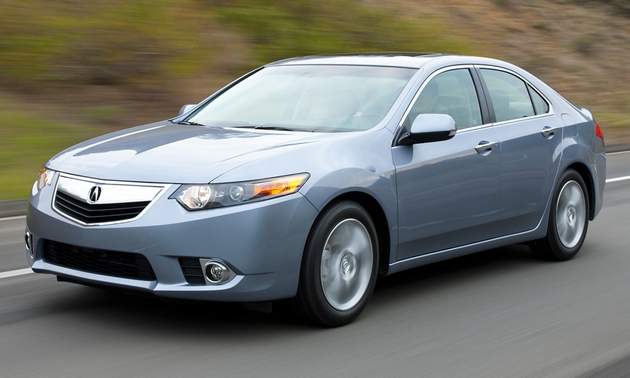
2011 Acura TSX Tech


This 2011 Acura TSX Tech is Exhibit A on how small-displacement engines can still add up to a lot of fun. The 2.4-liter four-banger under the hood makes just 201 hp, but because of a terrific short-throw six-speed manual, a great chassis with a (sometimes overly) firm suspension and direct steering, you maximize every last pony at your disposal. Really, if I could change one thing about this car, it would be to have that great powerplant drive the rear wheels instead of the front ones.

The overall balance of this Acura is terrific, and the handling is as good as any front-driver on the market. This is a fun car to grab a lower gear, toss into a corner and put the power down, look for the exit and then hopefully, another corner just around the bend. This is one of those cars that rewards aggressive driving, letting you know at all times exactly where you are at on the road.

Combine all of these great handling attributes with what is arguably one of the best sound systems on wheels, and you have a rather compelling overall package. As a daily driver, you could certainly do a whole lot worse for your $35,000.

You're right, Roger. You could do a whole lot worse for a daily driver. In fact, if I was looking for a daily driver of my own, the Acura TSX would be it. It's no secret that I'm a Honda/Acura fan (though, it's becoming more difficult with each passing year) and I love this K-series engine and six-speed manual drivetrain combination. The shifter is precise and clutch take-up is tuned to my liking in the middle of the pedal stroke.

The 2.4-liter four-cylinder is smooth and revs effortlessly to its 7,000-rpm redline. As is standard procedure with these high-strung Honda engines, you need to keep the revs up to stay in the power and that's something I enjoy doing. This coming from someone who autocrossed my brother's Integra Type R (8,400-rpm redline) a lot before and currently has a S2000 CR (8,000-rpm redline) in the garage.

Besides the drivetrain, the chassis tuning is also something I like a lot. The steering is hypersensitive and will catch people by surprise in the beginning, but you get acclimated to it easily and will end up enjoying it when placing the car wherever you want, whenever you want is so easy. The suspension is stiffer, while not punishing you during normal commutes. The overall result is a car that feels eager and light on its feet even weighing in at 3,400 pounds.

As much as I like this car, I'm not under the illusion that the blade/beak front grille looks good. I will say that the TSX is probably the best integration of the hideous front end, though. The rest of the exterior is clean and sharp-looking with the subtle wheel arches.

Inside, the cabin is great with supportive and comfortable front bucket seats. It's easy to find a good seating position, and the minefield of buttons on the center stack to control radio/climate/navigation functions is overwhelming at first glance but is easily picked up. Would you rather have an iDrive-like system, a touch screen or a bunch of buttons? I'll take buttons every time.

On our Technology package model, the ELS audio system sounds great and is one of my favorite setups. The navigation system is also intuitive, and the rearview camera projects a nice, clear image on the center screen.

My best piece of advice to those shopping a TSX is to resist going with the more powerful V6 model and get the four-cylinder with the six-speed manual. However, if you want the technology stuff with that drivetrain, you best run to the dealership now to find a leftover 2011 model. Acura won't be offering the Technology package with the I4 and manual for 2012, which I think is a shame. Instead, it will only be offered on the more performance-oriented Special Edition models, which I do look forward to driving.

2011 Acura TSX Tech

Base Price: $35,595

As-Tested Price: $35,595

Drivetrain: 2.4-liter I4; FWD, six-speed manual

Output: 201 hp @ 7,000 rpm, 172 lb-ft @ 4,300 rpm

Curb Weight: 3,400 lb

Fuel Economy (EPA/AW): 24/24.1 mpg

21 Eylül 2011 Çarşamba

2011 Volkswagen Routan SE


This 2011 Volkswagen Routan SE ain't no Microbus, and it's not even the best of this breed of minivan (read: Chrysler). That's not to say it's a poor vehicle--all Chrysler, Dodge and VW versions of this van are strong, but this one might not be worth the bother to get the German label. This essentially is a Dodge Grand Caravan with some noticeably lacking features such as automatic headlights and automatic climate control. Those are odd omissions. So what you get is a nice Dodge minivan with navigation and buff interior trim. Is that worth the VW experience? Not so sure.

On the downside, the interior roof-rail system in this vehicle is so creaky and clunky that it reminds of bad panel vans of old. It's a rattletrap.

I've been on the disabled list lately, so I now pay special attention to a vehicle's ease of use, and this Routan has functionality for people who are physically challenged covered in spades. The power options really ease entry and exit. Being able to open the power rear liftgate to load a chair or a wheeled crutch is a huge help, as is popping open the power sliding driver's side door to easily load crutches and backpacks and other carry-ons. The ride height allows for easy in and out, though it'd be helpful to have power pedal adjustments and a telescoping steering wheel to help fit the driving position around encumbrances such as oversized casts and boots.

Overall, this is a handy vehicle for anyone who needs or values ease of access and ingress/egress.

As Bob said, this isn't a VW bus but simply a rebadged Chrysler. OK, the Volkswagen version has different suspension tuning and its own front and rear fascia, but there's not much else to distinguish itself.

Visually, the changes aren't enough. It lacks the coolness and funkiness of a Microbus, and the interior is equally as boring as the outside. Volkswagen usually excels in the interior department, but the Routan is an exception.

On the road this, the 3.6-liter V6 offers healthy pickup and it rides comfortably on the expressway and around town. It's also a respectable handler for a minivan, but it's far from exciting. Then again, what minivan is?

2011 Audi A3 2.0 TFSI Premium


I've gone on record dozens of times saying how much I love this chassis and engine combination in the 2011 Audi A3. I do think it's a little pricey, but this is a nice little car if you're willing to part with the extra dough to move up from a Volkswagen to what an Audi will cost you.

The build quality is among the best in the biz (the back seat is a little tight), it's the right size and it's plenty fast enough. It drives like a little sportster around town. Jump on the gas from a light and there is a little bit of turbo lag at the lower revs, but boost builds quickly and the engine has good response above 3,000 rpm. It drives like a bigger car on the freeway. It's clearly tuned for autobahn speeds. Composed is the word that comes to mind.

The seats are above average, and I found a nice comfortable driving position.

I enjoyed my drive in the A3; I always do. But I don't see one tempting me away from a Volkswagen GTI.

If you need a car without a third pedal, it's hard to go wrong with this combo--it's one of my favorite small-car powertrains. The torque of the turbocharged four-cylinder really moves the A3 along with authority, and once you've driven the S tronic six-speed you'll wonder how other manufacturers can get dual-clutch transmissions so wrong. (Ford, I'm looking at you.)

Inside, the Audi feels upscale but not overly so. What was a premium small-car interior two years ago is now just competitive, thanks to the onslaught of upgraded compacts such as the Ford Focus. Similarly, interior room is nothing special. Despite its almost wagon-esque exterior design, this is a compact hatch, a truth immediately apparent as soon as one pops the fifth door.

Perhaps the larger problem is that the Audi A3 really is priced at a premium to other really good small cars. More than $31,000 for a vehicle in this category stings a bit, particularly when as much as $1,500 of that price is wrapped up in options such as metallic paint, heated seats and Bluetooth capability, which I'd expect to find included in a compact with a base price just shy of $30,000.

I'd imagine that's why I see so few A3s on the road. Most folks cross-shopping them probably end up either swallowing the few extra grand to move up to an A4 or they look at other larger competitive options at the same price point. As Wes mentioned, squeezed between the GTI and the A4, it's hard to make a solid case for an A3.

NEWS EDITOR GREG MIGLIORE: The reflexes of this 2011 Audi A3 Premium are outstanding. It drives with the energy and athleticism of a car that wants to be driven and has guts. The chassis is composed and sporty, and the steering has a light but pleasing response. It's a fun, practical thing to drive.

I found myself tossing it into corners and pushing it, just because it's a fun thing to do on a late summer morning as the sun slowly rose. This powertrain is outstanding, with plenty of power low in the band and a hefty dose of torque served up in enjoyable fashion. I knifed in an out of traffic with ease and jetted through congestion on the expressway. The driver is close to the ground, connected and invigorated. Frankly, it feels lighter than 3,200 or so pounds.

If we have to accept smaller cars, this is a good one. Still, I'd say the interior is just OK. As Stoy notes, cabin furnishings have gotten so much better; this is just solid. Not bad, but solid. Overall, this would be a great runner for daily commutes.

2011 Audi A3 2.0 TFSI Premium

Base Price: $29,625

As-Tested Price: $31,200

Drivetrain: 2.0-liter turbocharged I4; FWD, six-speed dual-clutch sequential manual

Output: 200 hp @ 5,100-6,000 rpm, 207 lb-ft @ 1,800-5,000 rpm

Curb Weight: 3,296 lb

Fuel Economy (EPA/AW): 24/23.4 mpg

16 Eylül 2011 Cuma

2011 GMC Terrain SLT-2


This 2011 GMC Terrain SLT-2 is a nice little crossover/ute that is exactly the type of vehicle on a lot of friends' radars these days. They want some utility to haul kids and stuff, yet they also want some halfway-decent fuel economy, as even when oil dropped below $100 per barrel, the needle at the fuel pump didn't drop all that much.

But the problem I have with the Terrain is twofold. First, the powertrain has a couple of little of hiccups. The engine is buzzy and the gearshifts are way too herky-jerky for a vehicle selling in today's market. I thought maybe the gearshift issue was one of it just being cold and that it would go away when it warmed up. After a while, it did seem to get a bit smoother, but automatics today make gear swaps seamlessly, and if you're producing one that doesn't you need to go back to the drawing board. As for the buzzy engine, I guess the little V6 is struggling hauling around nearly two tons.

My second issue is on the inside of the Terrain. There's a ton of hard plastic in here, and while the top of the instrument panel has some soft-touch, topped-stitched what looks like leather, the majority of the dash is filled with some inexpensive-looking plastic. And what's worse, some plastic that's done up to look like chrome, which makes it look even worse.

The exterior design is handsome enough, the wheels and tires look good and the seats were comfortable. As I said, the vehicle is certainly the size that many folks are looking for today. But the Terrain is just a bit too rough around the edges. And with this being a GMC, I'd think more attention would have been spent on the interior.

As Roger mentioned, the Terrain is just the kind of ride a lot of folks are seeking right now, evidenced in part by the consistently high sales numbers for its sister vehicle, the Chevrolet Equinox. The segment's popularity is also the main reason I was so surprised by the Terrain's deficiencies.

My primary concerns center on the Terrain driveline. The V6 feels weak. The six-speed automatic would shudder every time I slowed, and in traffic, the rubber-banding effect was disconcerting. It was bad enough to suspect that there might be something wrong with our particular vehicle.

The navigation interface felt at least a generation old, but otherwise I actually thought the interior was one of the nicer aspects of the Terrain. The contrasting materials with highlight stitching helped it feel open and airy, and the flat floor and sliding/reclining rear seats were easy to use and quite comfortable.

Then there's the sticker price. Close to $40,000 for a compact crossover, particularly one with amenities and appearance that are just good? No thanks, even if the sloppy powertrain was just an anomaly.

Yeah, the sticker on this 2011 GMC Terrain SLT-2 is a bit of a shocker, but it's easily whacked down by eliminating some of the stuff this car has--or better yet, getting the dealer to cut the price of them. I'd be willing to bet you get one of these out the door to closer to the $32,000 base price than this $38,000 sticker, making it more competitive with its rivals.

That said, I didn't experience the drivetrain difficulties mentioned above. I thought the six-cylinder was powerful enough and the transmission was smooth. I drove it both in traffic and on the freeway. No muss, no fuss. I might have to drive it again to see whether I can duplicate the rubber-banding mentioned, or perhaps the four-cylinder is the way to go. Meanwhile, the steering is overboosted and the suspension is soft, but aren't they all in this class?

Yes, there are some inexpensive bits inside, but at least the design is decent and the sliding rear seats work easily.

2011 Kia Forte SX


The 2011 Kia Forte SX sedan is respectable, with decent power, slightly above average looks and an eager chassis, but it's nothing remarkable. It's competitive but not class-leading. Still, it's well-executed in most respects and it's a step forward for Kia.

The chassis is tight, perhaps a bit more so than most cars in this segment. The body is reasonably controlled, and aggressively cornering and bouncing over roads returned a rather invigorating experience. I took a curve just outside of One Autoweek Tower with serious energy, pushing the body and chassis, but the Kia responded. Intense driving isn't this car's forte (I know, I know), but it is capable of some verve.

The four-banger is just OK. The paddles bring some life to the experience but overall, the power is just passable. The interior is plain, with just a few highlights in the dials and accents. Otherwise, the materials are a touch too blasé. I like the styling on the outside, which is understated yet well anchored in contemporary design language. Kia is getting ever more formidable, and the Forte is part of a solid product salvo.
My choice for the weekend was this Kia Forte SX or the Mazda 5 minivan. No surprise, I went with the sedan. We've been talking about how Kia has been stepping it up for a while now, and this is just another example. The sheetmetal has a clean look to it with the shape of the last generation Acura TSX, especially in the back. The front end looks a bit cheesy to my eyes, but taken as a package, the top trim of the Forte looks good.

The interior would be a bit underwhelming if the price wasn't so low. I would have guessed a bit higher than $23,000. The seats are comfortable but the high seating position ruins any sporty feeling for me. It has an adjuster lever, but when I got in, it was in its lowest position. I did get used to it after a while but it feels like you're sitting on top of the car, instead of in it.

The radio, navigation and steering-wheel controls worked well, and I love the navigation system that Kia and Hyundai are using. It's easy to use and easy to see, except in direct sunlight. The rearview camera is a good option to have at this price.

The touch points are mostly hard plastic and a bit inexpensive feeling, especially in the armrests, which bugs me to no end.

The SX is the sporty Forte and had the paddle shifters to prove it. It has a standard torque-converter transmission but the shifts were relatively quick. It's always a bit fun to grab a few lower gears and make a pass on the expressway. The SX gets the upgraded suspension, which has a nice sporty feel without beating you up too much. Much of my weekend was spend on dirt roads where the SX was easy to handle and slide around.

It seemed to be tuned pretty aggressively. Just a slight tip of the throttle and the car is off and running. Same thing for the brakes; it took a feather-light foot to do it smoothly.

Lastly, it's always nice to see something clever in these econo cars. The Kia has pulls in the trunk to send the back seats down. It's a convenient feature. They also double as hooks for grocery bags, which I needed as well.

9 Eylül 2011 Cuma

2011 Hyundai Genesis Coupe 3.8 Track


This Genesis Coupe 3.8 Track is the best Hyundai that I've driven, hands down. It's not perfect, though. The steering, while trying to be direct in offering good feedback, is just way too twitchy. Sneeze at the wrong time and you're in a ditch. And for a car with as much sporting ambitions as this one, the brakes need to bite much harder and quicker than these do. While I have just the two complaints, they're both important matters for a car that has the word "Track" in its name.

The driveline in this car is good. The V6 spins up to redline rather quickly. Clutch engagement is quick and near the top of the pedal travel, and the shifter engages the gears with relatively short throws. The interior layout is rather straightforward, albeit with a couple of gimmicks. The torque graph on the top of the dash is particularly gimmicky.

I have long complained about two things in Hyundai vehicles: the flat-bottom seats that offer little support and the suspensions that fail to limit body roll or absorb much of the harshness of imperfect roads. With this car, I have no complaints about the seats or suspension. The seats are comfortable and supportive and the suspension is firm without being too harsh.

Overall, this is a car I'd like to spend some more time with, either on a track or a cross-country drive.

I came out of the Ford Mustang V6 and went directly into the Hyundai Genesis coupe, arguably the Mustang's closest import competitor. Whether the market considers that to be the case or not, the two cars are similar on paper yet just as dissimilar behind the wheel.

Where the Mustang feels somewhat plodding and heavy, the Hyundai appears a few hundred pounds lighter than it is. But the Genesis is also a much more challenging car to drive smoothly, with a stiff clutch, quick takeup and a notchy, awkwardly placed shifter. It was by far the sportier of the two vehicles but at the end of the day, I'd rather have the easy driving dynamics of the Mustang. It likely comes down to the Ford being tuned for a wider audience than the Hyundai, which feels finely focused on the male-youth performance market.

Inside, the Genesis is refreshingly open and reasonably well trimmed, with supportive seats and a good driving position. But quiet it isn't; road rumble is present and the grumble of the V6 is ever-present as well. It's nice, though, as it has the same cammy mechanical sound as the Mustang's 3.7-liter powerplant, and it doesn't sound as though there's some missing insulation on the firewall as one could argue about the Ford.

Exterior styling being subjective, I vastly prefer the Mustang's appearance. The Hyundai is worlds better than the Tiburon it replaced, but the front of the car has a shovel-nosed appearance that makes it look way wider than the rest of the body.

So the Genesis coupe is far from perfect. But considering where Hyundai was just a decade ago, this is yet another car from the Korean automaker that should have every competitor sitting up and taking notice.

I was impressed with this 2011 Hyundai Genesis Coupe 3.8 Track. It's a really good-looking coupe and there's good power from the six, which has a nice growl to it.

The interior is upscale, more on, say, an Infiniti scale than what we're used to from Hyundai. The seats are comfortable, everything is where it should be, it seems nice and gimmick-free and the material quality was better than decent. Plenty of room for me, too.

Driving the car, I thought it felt tight and responsive. There's good grip and the body stays flat. I loved the steering, too.

I have not driven this car without the Track package so I don't have much base of comparison. But I can say the car didn't beat on me here in Detroit, and that's something one can't say about a lot of cars with "tuned" suspensions. I thought the ride was just fine.

Overall, I was quite impressed. I would love to try one with the 2.0-liter turbocharged four-cylinder.

2011 Porsche 911 Carrera GTS


Every time I get out of a Porsche 911, I wonder why, if you had the means, would you drive anything else? This car comes about as close to a machine becoming an extension of you as any car I've driven. It's easy to dive in and out of traffic on the freeway, and with all of that power, way too easy to cruise way beyond the legal speed limit. The speed comes on effortlessly and before you know it, triple digits are registering.

The GTS model has 23 more horsepower than a 911 Carrera S, but it's difficult to really sort that out during a daily commute. Maybe the extra ponies would make themselves more known at the track, or on the autobahn. On the interstates in Michigan, it was difficult to notice them.

The 911 is always a joy to drive. With the Alcantara-covered wheel to the outstanding brakes, this is a terrific car. And it looked absolutely stunning sitting in my garage this morning. It's something I could get used to seeing.

Other than allowing you to say, "My 911 is a GTS," I'm having a hard time justifying the substantial price jump from this Carrera S to the GTS. An extra 23 hp is nice, but it's far, far from changing the Carrera S experience in any significant way.

I'm quite familiar with 911s, and various versions of the car top my personal wish list. However, from what my drive in this car told me, I wouldn't spend a moment wishing I had spent the extra money on a GTS over a standard S. Porsche is squeezing every last bit it can out of the Carrera range before the next iteration arrives, but there's just no reason to buy into the 11th-hour madness.

But I want to look at the final sticker on a similarly equipped Carrera S. If it ends up being pretty close, then yeah, might as well go with the GTS.
What separates a Carrera S from a Carrera GTS? For starters, the GTS puts an $11,200 bigger dent in your pocketbook if you compare base prices, but you do get more in the GTS. More begins with the additional 23 hp that Mac and Roger mention above. Torque remains the same at 310 lb-ft but comes 200 rpm earlier at 4,200 rpm, compared with that on the S. Top speed of the GTS is 2 mph higher in the GTS at 188 mph and it gets to 60 mph in 4.2 seconds with the dual-clutch transmission, which is a smidge quicker than the S's 4.3-second time with the same gearbox, according to Porsche.

Visually, the GTS gains the wide bodywork from the all-wheel-drive models, a wider track, center-mount RS Spyder wheels with meaty 305/30R-19 tires in back, a different lower front fascia and side skirts. All of the exterior jewelry is painted black, which gives our particular black test car an even more sinister appearance.

In the cabin, the sport seats get Alcantara inserts to keep occupants better held in place, and Alcantara is also used to cover the steering wheel and the parking-brake handle.

Driving the GTS is, as expected, nothing short of spectacular. The boxer six-cylinder is eager and pulls throughout the rev range. The ZF gearbox is one of the best dual-clutch units available, with impeccable shift response. Steering is direct with loads of feedback and satisfying weight, and the brakes are typical Porsche strong. Find some corners and the GTS is unflappable, with more grip and capabilities than you'll ever be able to exhaust on the streets.

Porsche says it did the GTS to close the gap between the S and the GT3 with 435 hp. I didn't really think that gap was in need of filling, but with this generation of the 911 heading off in the sunset, you can't fault Porsche of squeezing ever last drop out of the 997 in its last year. And in Porsche terms, an $11,000 price jump isn't exactly jaw-dropping. You get some extra power, a wide body, slicker wheels and some fancy interior touches. I wouldn't blame you for throwing down for the GTS over the S.

If this is compromise, somebody alert Congress. The 2011 Porsche 911 Carrera GTS is supposed to be the perfect balance between screamers like the GT3 and the GT3 RS and the lower orders of Carrera. Well, frankly, I would take any of them, but the GTS is less severe and more liveable than a GT3 while allowing you to safely approach the GT3's handling prowess. It is maybe the fastest car you could drive every day, though, again, I would drive any of them every day. I'd be like the rat in the experiment that keeps hitting the "pleasure" button until it collapses from joy.

In this case (though the car is full of them) the pleasure button is perhaps the seven-speed PDK transmission on the GTS that I drove in Los Angles. In "D," in case you are trying to save gas or for some other reason restrain yourself, it upshifts way early. Use the shifter paddles while the trans is in D and it'll shift where you want it to shift but will then go back on its own to upshifting early. However, knock the shifter lever over to the left and it'll hold gears, allowing you to maintain composure through a turn, though if you forget and stop for a while at a red light it'll start in first. In sport and sport-plus it will hold gears and shift at higher rpm.

In any case, you get an awful lot out of the 408-hp flat-six with this. I got a 4.3-second 0-to-60-mph time, for instance, using our Racelogic timing device. Just step on the gas and go. I did not try the top track speed of 188 mph, but I have no reason to doubt it. If you insist on having angst you could say that the GT3 is best for great mountain roads and the simple Carrera is best for freeways. Frankly, you need to have one of each. But if you can't do that, the GTS is the best of all worlds.

That is, until the new 911 debuts at Frankfurt.

2 Eylül 2011 Cuma

2011 Cadillac Escalade ESV Platinum


The 2011 Cadillac Escalade ESV Platinum is everything a luxury-laden SUV should be: comfortable, powerful and blinged-out. This Cadillac is impressive. It makes jaws drop and makes people drool. This is the modern equivalent of the 1959 Eldorado, which was a halo for the brand when it was the standard of the world.

Really, this is a well-executed ute in every way. The V8 is a monster, and it's needed to propel this hulk along in reasonable fashion. It's big, and the driving position is domineering. Inside is a sumptuous cabin that's as well appointed as it is huge. The leather, the stitching, the badging everywhere--I found it all impressive.

The outside is equally eye-catching, with vents, chrome and over-the-top headlights. I think it all presents sharply. I like this slightly better than our long-term Infiniti QX56, but there are really only a few choices in this class.

General Motors makes solid SUVs, and this is the top of the line. My only beef is that you can get pretty much the same ute (minus the bling) in Chevrolet and GMC trim for a lot less than $88,000.
I never really understood the appeal of the gigantic SUV until I drove this one.

As mentioned, the commanding driving position is something I have longed for ever since climbing down and out of this ute. The panoramic views from the opulent interior spoiled me and made me lust for the one person in an eight-person truck scenario soon after.

It felt as if I could store all of my possessions inside the cavernous interior with space to spare. Despite feeling so large on the outside, it wasn't a problem to drive or parallel park downtown either, a big surprise.

Cosmetically, the Escalade has come a long way. The more refined look of this SUV sits well with me. Twenty-two-inch wheels come standard but look surprisingly small on the gargantuan exterior.

The engine is strong and sounds good. Don't expect to break land-speed records, but once the momentum is going, it has some oomph when you put the hammer down.

Obviously gas mileage isn't car-level, but it could be worse for something this size. And despite having more electronics and gadgetry than most, the Escalade lacks a steering column that moves forward and back. Really, Cadillac?

Despite the negatives, I now understand the appeal of the SUV and would put the Cadillac high on my list of spacious utes in which you can haul 1.5 families in comfort and with ease.

If this truck is in your budget, and you have no problem showing everyone that you spent a chunk of money, this is a good route to take.
Where am I, stuck inside a music video? And one from about 10 years ago, no less?

Yes, it's flashy, though I suppose no more so than plenty of other cars, SUVs and trucks. Yes, it's big. It gets me every time with its size, and I start to think that it's a hell of a useable machine, if you have a spouse and three or more kids, and you all ride together routinely.

This example was screwed together well, it featured nice leather seats and was comfortable to drive, other than the nontelescoping steering wheel. That's definitely an odd feature to lack on such a mammoth, when I wonder how many equally (in human terms) mammoth people drive one of these.

But Escalades have come a long way from the Chevrolet Suburbans of yesteryear, and it's a quite comfortable and easy SUV to pilot. Just remember to give yourself ample room for cornering angles, and you need a fair amount of distance to bring the Cadillac to a full stop from speed. That's where I'm apprehensive about these full-size monsters. Everything is good under normal, relaxed circumstances, but I don't want to find myself behind this wheel in a fast-developing emergency situation that calls for quick reactions from both driver and vehicle. In that case, I guess you just do and hope for the best.

Overall, however, I feel ridiculous driving around alone in the Escalade. I feel even more ridiculous when people pull up next to me, excited and showing thumbs-up signs and yelling things like, "Yo, that's tight!" I want to scream, "No, no! It's not mine! Really, no!" I always feel as if I should go pick up six people to travel with me everywhere I go, just to improve my efficiency.

It's not often I need to carry around a bunch of people being a single guy and all, but a friend asked me to drive him and his family to the airport and pick them up when they returned from a cruise. Easy enough, but the thing is that he has two teenage boys who are both roughly six-foot-three. Then add in my friend, who is six-foot-one, his wife, daughter and luggage. So we're talking about a good-sized family of five and gear for a weeklong trip.

He asked me if I could get something big enough to handle the job. "Oh, yeah," I said, "I can get something big enough." When I showed up in this 2011 Cadillac Escalade ESV Platinum, it swallowed both the human cargo and the luggage with ease. All of them were amazed by the trick power running boards and nicely trimmed interior with the leather-wrapped dashboards and door panels, which were mostly covered with soft-touch materials. To my eye, the wood and aluminum trims are nice and, combined with all of the leather, helped distinguish the Escalade's interior from that of the everyday man's Chevrolet Suburban. Of course, at $88,000 it better go above and beyond.

Other Platinum-model exclusives include the higher grade Tehama aniline leather for the first- and second-row seats, which are real soft and comfortable. There also are Platinum-specific scuff plates, heated and cooled front cupholders, a heated steering wheel, power liftgate and a rear entertainment system with dual front-seat-headrest-mounted monitors. But the big standard features are the magnetic-ride-control suspension, LED headlights and massive 22-inch rims.

During my couple of days, I spent a good amount of time just driving around with one passenger, which was an utter waste of the Escalade's capabilities. But I did wheel it around some tight parking garages and lots in Ann Arbor and Ypsilanti and with the backup camera and light steering effort, I was able to easily shoehorn this thing into some tight parking spots.

Strangely, I didn't find myself hating this giant. I don't really mind any of these GMT-900s and was rather fond of our long-term Chevrolet Suburban from all those years ago. For a full-frame SUV, GM does a really good job from a ride-comfort and handling standpoint. The magnetic ride suspension should probably also be credited for this Caddy's luxurylike demeanor. Going down the expressway at 80 mph or rolling around the city at 25 mph, this does it all well. I also have to say that GM is probably the best around when it comes to big SUV brakes (minus the hybrids)--they are strong with a firm pedal feel.

The 6.2-liter V8 moved this big thing around easily and helped it merge onto the expressway without issue. The six-speed automatic is also smooth.

I was also surprised at how much attention this thing got--both from people who liked it and from people who didn't. I was flipped the bird in Ann Arbor for no apparent reason one night and on the other, I had a guy in an old Land Rover Discovery chase me down, pull up next to me and give me the thumbs-up while grinning ear to ear.

If you have a giant family and want to roll in more than respectable luxury, you could do a lot worse than this Cadillac. If you think it's too expensive and you could do without a few of the luxury touches, you could always go for the GMC Yukon XL Denali and save thousands.

2011 Volkswagen Jetta SEL


I was looking forward to getting my hands on this 2011 Volkswagen Jetta SEL. I owned a 1999 Jetta, the first year after they switched to a more rounded body style, and remember it as a car that drove well and was nicely appointed, even if it was hardly a paragon of reliability. Given criticisms of the newest Jetta, I wanted to see whether it was as bad as folks had made it out to be.

My conclusions are mixed. The exterior styling doesn't bother me, nor does the interior until you touch it. I haven't been surrounded by that much molded hard plastic in a long time, even in some stripper cars we've had through here. My '99 was filled with pleasing textures, soft touch points and chrome/metal touches. Our tester had the push-button start system, which in this case is just a square button placed in one of the four blanks in the console; the steering column even has a plastic cap over where the keyhole would be. Alone, this isn't an issue, but it's a perfect example of the corner-cutting VW engaged in with this car.

Another notable cost-cutting area is the clutch and manual-transmission linkage. The shifter is balky and rough--you can almost feel the cables rattling around in the tunnel--and the clutch has zero feel. I'm sure most Jettas are sold with the automatic nowadays, but it is disappointing that VW didn't give the stick a more sporting feel.

One area I've heard complaints is with the 2.5-liter inline five-cylinder engine. I actually found this mill surprisingly entertaining between 3,000 rpm and 5,000 rpm, with nice torque and a sound reminiscent of a turbo Subaru flat-four. It had no trouble pulling the Jetta around, and if it actually manages a combined 26 mpg, it's a decent compromise. Chances are, if you drive it like it needs to be driven, you're not going to see that kind of mileage.

Brakes and steering were still Jetta-sharp, and I can't comment on handling at the extremes since my drive time was limited to surface streets and heavy traffic.

So here we are, at $23K and change. That's a pretty heavily populated vehicle segment at the moment, and the competition is fierce. Ironically, Volkswagen decided to decontent just as Ford, Chevrolet and others elected to load up their compacts. As a result, sharp-handling, good-looking domestics have suddenly leapfrogged VW in interior design and driving dynamics--with Volkswagen's help.

The new Jetta is finding plenty of buyers thanks to its lower price. But the compromises in its design and layout mean it's outclassed in nearly every way by the Ford Focus and the Chevrolet Cruze.

This Jetta was a comfortable, fairly enjoyable ride for me as I darted around town over the weekend. The manual was engaging with an easy, smooth clutch, and the level of interaction helped keep me alert and in the right frame of mind as I went from car show to car show.

The styling is well-executed on the outside, with sharp headlights and taillights and smart proportions. Inside, the materials are a bit bland. I'm not that offended by them, but they are rather pedestrian. The plastic cap of the ignition space looks pretty bad and is a little confusing at first.

I found the steering to be light and quick, and this sedan's 3,045-pound curb weight makes for an even drive character. The chassis is a bit firmer, and road imperfections are felt at times, though the ride is also sportier than perhaps one would expect. The fuel economy is stellar; I drained the tank and recorded 27.24 mpg, with plenty of hard acceleration and stress-relieving downshifting.

The Jetta presents a decent, well-rounded package, and for the price it's nicely equipped. But the Hyundai Sonata and several others are well ahead of this VW.

Like others, I have mixed feelings for the Jetta. On the one hand I think VW seriously dumbed down the exterior and cheapened the interior so drastically it went from one of the best in the business to one of the worst at this price point. I really am gobsmacked at how bad the materials are, especially when compared the excellence VW did for years.

That said, in its cost-cutting craziness, I don't think VW messed with the drivetrain or suspension, and that's a good thing. I don't dig the five-cylinder; I'd much rather have the 2.0-liter turbo, which is coming in the GLI. The five does indeed wake up from its nap above 3,000 rpm, but up there and higher, it sounds like Subaru's flat-four, as noted above.

I liked the ride/handling/steering. Around town it's zippy enough and on the freeway drives solid and firm like a good German car should.

Still, in this price bracket, I'd look at the Ford Focus, the Chevrolet Cruze, the Mazda 3 and the Hyundai Elantra long before the Jetta.

VW made big changes to the exterior for the new Jetta, and at first, I hated it. But the more I look at it, the less it bothers me. The shape got a bit more boring but it's still a good-looking sedan. And it looks decent with the rim choice. It's definitely more grown up.

Power is serviceable from the five-cylinder but as Wes said, the 2.0-liter turbo would be better and more engaging. On the other hand, 27 mpg is pretty good from Greg, and I got 23. It does start to get going at higher revs, though.

The shifter is solid and I didn't really notice the sloppy, cable feel Andy is talking about. The throws are longer, sure, and I banged my elbow a few times on the armrest, but the gates are easy to hit. Clutch-pedal action is too soft for my taste, but it seems to grab pretty well.

I didn't hate the interior like some of the other editors did. It seemed a bit inexpensive-looking, but the only things I noticed were the hard armrest and the plastic plug over on the column where the keyhole was. I still love the way VW sunroofs operate--one twist of the knob and it slides fully open. Also, you can close it when the car is turned off, which is a bonus when you forget to do that before you take the keys out.

The radio setup is one of the best of the small-sedan bunch; good size, color screen with iPod controls and a serviceable speaker setup. The controls will take some time to get used to though.

For me, the Jetta is definitely a player in the small-sedan market. You can get a base Hyundai Sonata for less, but it's no more fun than this car.

2011 BMW M3 Coupe


A couple of days driving this 2011 BMW M3 coupe and it's easy to see why this is the benchmark by which all other sport coupes are measured. The V8 is terrific, and while it peaks at more than 400 hp, it somehow felt even more powerful. With the six-speed manual, you can easily keep the revs in the sweet spot. I found myself driving for a while in third gear, just to hear the great engine note blast out of the quad exhausts.

The attention to detail in the way the car steers and brakes is evident--everything is tight. This is, in effect, a race car. The steering is spot on, the feedback letting you know exactly where the front tires are at any given time. And because this thing is capable of warp speed, the brakes, with the cross-drilled and ventilated rotors that come with the sport package, are outstanding. In freeway driving, you need to realize that you will be able to stop much more quickly--if necessary--than just about anyone else you are sharing the road with.

The transmission has nice short throws to facilitate changing gears. The clutch takeup is also excellent, up near the top of the pedal travel. And the pedals are perfectly spaced for heel-and-toe shifting.


I found the mechanically operated seats to be a pain to try to find a comfortable seating position. For nearly $70K, can I get electrically controlled seats? Would it really add that much weight? And I would love to see BMW come up with a new radio interface for cars without a navigation system and iDrive. The technology there is at least a decade (or more) old. And while the iPod interface works, to scroll through the song menu you need a copilot operating the system. It takes so long that if the driver were doing it, you'd be in the ditch way before you found your favorite Willie Nelson tune.

But, hey, the M3 is about as close to a race car for the street as you can buy, and the driving experience from that standpoint is hard to beat.


We've heaped a lot of praise onto the BMW M3 over the years, and deservingly so. From a chassis dynamics standpoint, few companies do it as well as BMW. The suspension keeps it confidently stuck through corners, steering is precise and offers good feedback through the wheel, and ride quality is more than manageable for the times when you're not slinging it around hard. The 4.0-liter V8 has phenomenal throttle response with a stratospheric 8,400-rpm redline. As Roger said, the M3 remains the car that other car companies strive to beat in this segment.

What I don't agree with Roger on is the transmission. Of course, kudos to BMW for continuing to offer the M3 with a six-speed manual in addition to pleasing the dual-clutch sequential manual folks by offering a seven-speed box. But I do wish BMW would tune the shifter for a crisper and more precise operation. Acura and Audi manuals offer way better shift actions, in my opinion. The springy clutch pedal is another thing I'm not high on. Does it work? Yeah, for certain, but it's just one of those things that you wish could be a tad better.

This particular 2011 M3 was light on the tech features, which was nice. No iDrive, navigation and satellite radio to fool around with (OK, I did miss the sat radio a bit). The seats were manual, and I didn't like those at all. Attempting to find a comfortable seating position is difficult and the seat themselves don't offer the levels of side support you need in a car like this. A set of sport buckets like what Audi puts in the S4 are sorely needed.

But when it comes to the overall driving experience, no other car in this class delivers as strong in all areas as the BMW M3. Not the Lexus IS-F or the Mercedes-Benz C63 AMG. Neither of those offers a true manual gearbox or has a chassis as well sorted as the BMW's. Sure, they are more powerful. The Lexus's 5.0-liter V8 spits out a smidge more horsepower at 416, while the Benz's 6.2-liter V8 does a good amount more at 451 hp. They both out-torque the Bimmer's 295 lb-ft, with the IS-F delivering 371 lb-ft and the C63 AMG ringing up 443 lb-ft.

Still, even being outmotored, the BMW isn't too far behind to 60 mph, according to the manufacturer's published performance figures. BMW says this M3 with the manual transmission reaches 60 mph from a standstill in 4.7 seconds, while the Lexus does it in 4.6 seconds and the Mercedes is the fastest of them all at 4.4 seconds.

However, with the dual-clutch transmission, BMW says 0-to-60-mph times drop to 4.5 seconds, which would be faster than the Lexus but still slower than the Benz. Of course, does this really matter? It's just splitting hairs here and in the end, all three are really darn fast.

The good news for consumers is that all three bring different characteristics to the table. In my opinion, the Lexus is the third-place entry, while the BMW and the Mercedes swap first and second. Sometimes the Benz's throaty V8 and raw power gets me, while at other times I prefer the BMW's balanced attack.

I agree with Roger and Jon, the M3 coupe remains the benchmark for this segment. It's powerful, luxurious and well-executed in everyway that matters. The engine is a rocket, with an imposing sound and sinister exhaust note. The six-speed manual is a gem, and it's thoroughly enjoyable and interactive for enthusiasts who want to channel all of this copious power themselves.

The chassis is solid, and the body is taut and composed. Turns and curves are little trouble, and the driver feeds off this car's energy. I like the subtle looks too. The badging, the domed hood, the curved fenders--it's all impressive without being overwrought.

My dislikes were more along the lines of nitpicking. The mechanical seats seemed Paleozoic for a car this expensive, and the radio interface looked as if it was straight out of the 1980s. Where's the satellite radio, too? It comes on entry-level sedans, but not on one of the baddest sports coupes in the world?

All of that is overlooked when smoothly operating clutch and pedal as you blitz through traffic. It's truly a fun car. The M3 coupe also represents the best of the automobile world--power and luxury. Just be sure to take the manual.

Oh, if only every car could drive like this. I had this car for a night and hoped that I could have it longer--like, forever.

It's a sharp-looking car from the outside with the M3 badges, domed hood and carbon-fiber roof. But once you slide into the cabin, the disappointment sets in. This generation 3-series has been a around for a bit and it's glaringly apparent in the cabin. As others have mentioned, the radio interface looks really dated. Good thing the driving experience keeps you distracted from looking too deeply into the interior.

Speaking of driving experience, this car is tight and begs to be driven beyond a straight line. With its cornering prowess and six-speed manual gearbox, this car would be a blast for any driving enthusiast.

This is one of my traditional favorites, but I'm starting to look forward to the next generation. For all of the power, feel and handling prowess of the V8-engined M3, I miss its predecessors every time I drive it.

I don't want to say it feels heavy per se, even though it is quite, er, substantial, because BMW's V8 and world-class chassis/suspension tuning mask a lot of the heft. As always, you can throw this M3 around with abandon only to be rewarded at every curve in the road.

Still, there's just something about the car that bugs me, and it's more like the overall feeling it conveys to me rather than any single glaring deficiency. Little things like difficulty finding a good seating position, long shift throws and having to reach too far for the shifter itself and a rubber-band clutch annoy me more every time I sample this car.

The M3's handling, engine and overall experience still put it at the top of the sport-coupe/sport-sedan class, but as time goes on, I grow more certain that I won't ever miss this car the way I do the old ones when a replacement comes along.

I hope I haven't spoken too soon.

22 Ağustos 2011 Pazartesi

2011 Land Rover Range Rover HSE


The interior in the 2011 Land Rover Range Rover HSE is flat-out stunning in terms of looks, materials and initial build quality. This is by far the best SUV interior on the market, and one of the best in the overall market. The exterior is timeless, and the engine-trans-chassis combo is one of the few in the car business that would allow you to slowly pick your way through the jungle all day and afterward hose it off and drive it to the symphony that evening. Really, in how many cars can you do that? I think there is only one.

While I love the supercharged engine available, this normally aspirated V8 is not exactly a slouch. It's quiet and powerful and the shifts from the transmission are smooth to the point of being unnoticeable. The car drives well. It's comfortable with a little roll, but the ride soaks up Detroit streets like none other.

I like it a lot. Again, I love the supercharged model, but the regular V8 would do just fine, too.

I agree with Wes that the interior on this car is simply beautiful. The wood trim looks like something you'd see in a men's club. The interior is quite comfortable with nice little touches, such as the ability to adjust the height of the armrest, is just one of the ways Land Rover has paid attention to details. At freeway speed, this thing is amazingly quiet.

There are other things that frustrated me. All of the doors lock after putting the transmission in gear, and you cannot open them without using the central locking button, a small button located on the dash beneath the flashers. Or with the key fob. Speaking of which, do you really need something that big? (“Is that a Land Rover key fob, or are you happy to see me?”) Having to carry something that large around with you all of the time would be a pain.

I tried unsuccessfully to use the USB/iPod interface. It seems that, in order to attach an iPod, you need to have a special Land Rover iPod cable. You cannot connect via the USB port.

Overall, this is a great-riding, comfortable, capable sport-ute. And after spending a weekend behind the wheel, I think I'd still opt for a Jeep Grand Cherokee. It's just as capable, and maybe the wood trim isn't quite as nice, but it's just as comfortable, and with the Pentastar six-cylinder, it gets way better fuel economy. And I'd have $40,000 more left in my pocket.

Because I grew up driving on gravel back roads that would've made automaker torture tests look like child's play, I intuitively drive potholed roads in a manner that minimizes the jostling by taking the best of the bad choices. But in the 2011 Land Rover Range Rover HSE, I forgot about the bumps and more than once I deliberately aimed the vehicle directly at the potholes, just to see what would happen. Nothing, that's what. This big brute ute is so capable of smoothing out road surfaces that it's almost hard to find a normal pothole that registers all the way through the chassis to your seat. It's easy to see why vehicles of this brand and ilk have been the transportation of choice on many a harrowing backcountry expedition over the years.

I can see where the Range Rover is massively capable of hauling itself through just about anything Mother Earth could throw at it--snow, mud, water, sand. From my experience with this and its siblings, I'm quite sure it's up to the task. At the same time, the vehicle is pure luxury on the beaten path, riding high and mighty with nary a trace of odd chassis roll or steering wander. The vehicle is simply steady as she goes. Though this isn't the wicked supercharged Sport, this engine still packs a decent amount of power for the package.

Inside, the leather seats are firm and comfortable, the wood trims are exquisite, and even the parlor tricks such as the instrument panel's skyline-at-sundown display when you shut down the ignition are special. I'm all for “real” gauges, but having seen the clarity and icy-cool appearance of these new virtual LCD readouts on this and the Lamborghini Aventador, I am wholeheartedly embracing this future. I'm not quite so happy with the navigation/audio interface and while I hate to admit it, but this vehicle might actually benefit from some kind of iDrive-like controller for all of this stuff. But that might directly conflict with the Terrain Response Control knob occupying that real estate in the center console. Something has to be better than this touch screen/buttons setup, though.

In a week in which I had a couple of very interactive, sporty coupes, the 2011 Land Rover Range Rover HSE was my favorite test car simply for its relaxing cabin and sumptuous power from the V8. It's potent, and it takes off on the expressway. I really like the steering as well. It has a light feel, yet there's a lot of feedback and response. The black middle clock reminds of a vintage watch I considered buying.

The interior is well laid out, and the materials present in luxurious fashion. The wood, the leather, the accents--it's all here. Plus the road view is outstanding. It's a quiet setting, and the digital gauges are gorgeous and colorful. They remind me a bit of the setup in the Jaguar XJ.