21 Ekim 2011 Cuma

2012 Mazda 3 Skyactiv


Three months ago, we got to drive some riveted-together Mazda 6 mules with Skyactiv gasoline and diesel technologies beneath the hood. Those showed promise even in the larger, heavier Mazda 6 bodies. Now we've had a chance to drive a production 2012 Mazda 3 with a Skyactiv gasoline engine on a fun mountain road, and we came away even more impressed.

Skyactiv is Mazda's new approach to automotive efficiency. The heart of the 2012 Mazda 3 models we drove was their new high-compression Skyactiv gasoline direct-injection fours. Using direct injection, reduced back pressure and a number of other technologies, Mazda engineered this system to operate at a compression ratio of 14:1. That's unheard of in a mass-produced compact car. Even the Ferrari 458 Italia has only a 12.5:1 compression ratio. However, U.S.-spec Mazda 3s with Skyactiv will get only a 12:1 compression ratio because of two factors:

1. There's no room in the current Mazda 3 body to fit the requisite longer exhaust headers.

2. We Americans insist on using regular gasoline in everything, all the time.

Nonetheless, even at 12:1, the 2.0-liter four goes from 148 peak hp to 155 hp, while torque increases 10 percent to a 148-lb-ft peak and goes up 15 percent in mid and low ranges. Fuel economy goes up by 21 percent to 28 mpg city/40 mpg highway with the six-speed automatic.

Both six-speed manual and six-speed automatic transmissions are thoroughly revamped for more efficiency, too.


The 2012 Mazda 3 starts out as one of the most fun-to-drive cars in the compact class, and this one adds more power and quicker shifting to that equation. Power and torque bands are wide and flat, with power available almost all across the tach. The 155-hp peak comes at 6,000 rpm, but there's plenty of torque below that.

The fact that you can get a six-speed manual in this huge seller should garner some kind of medal for Mazda. The fact that the six-speed was reengineered with shorter throws and reduced friction just makes it all the better. It's almost Miata-like. The six-speed automatic is quick, too, with none of the low-speed slogging that accompanies DSGs from Volkswagen and others. A soul-sucking CVT was never considered.

The Mazda 3s we drove remained nicely balanced in the many corners into which we flung them; the 3 is truly one of the leaders in this class for driving glee. Steering feel from the electrohydraulic system (an electric motor powers the hydraulic pump) was direct and relatively tight, another much-appreciated feature.

The ride might seem a bit stiff for those seeking Toyota Corolla-like brain balm, but it felt entirely livable for everyday driving.

Do I want one?

There are seven engine and transmission pairings available with Skyactiv drivetrains (no diesel yet) in both sedan and hatchback body styles. There are even more powertrain combinations outside the Skyactiv line.

The base 2012 Mazda 3 with the old 2.0-liter MZR four, which does not have Skyactiv, can be had for just $15,995. Skyactiv comes with enough standard features to increase the price to $19,245. Above that in horsepower but without Skyactiv, the 2.5-liter four is still available, and at the top of the heap is the all-conquering Mazdaspeed 3 for about $24,000. So there are a lot of Mazda 3s out there.

The Skyactiv technology almost certainly will be adopted by other carmakers as a way to meet ever-increasing fuel-economy standards. Mazda is to be congratulated for bumping mileage up and still making cars that are fun to drive.

2011 Audi A5 2.0 TFSI Premium Plus Coupe


It seems to me that the 2011 Audi A5 coupe is the best-looking Audi aside from the hardtop R8. It has the purposeful nose of the brand with only two doors and the swoopy roofline. When it came out I was immediately impressed. The new wheel choices that debuted for 2011 nicely set the exterior package off.

The base price is about where you would expect it, at just less than $40,000. The Premium Plus trim adds some convenience features, but nothing I couldn't live without. However, I would miss the xenon headlights, but that's about it.

The Sport package is a must. It adds the sport suspension, big wheels and sport seats. If you only checked that box, you could get out of the dealership for less than $40,000. It does surprise me that you can't get a V6 in the A5 anymore. The turbocharged 2.0-liter does its job well, and the gas-mileage bonus is probably worth the drop in power. The A5 never felt sluggish, but a bit more grunt would have been welcomed. At least the coupe gets either the manual or the eight-speed automatic, and not the CVT like the A5 cabriolet.

On the subject of transmissions, this one has the six-speed manual. The throws seem long and a little sloppy. The second-to-third shift in particular seems difficult to hit with any sort of gusto. Lots of elbow movement. The clutch pedal has a lot of travel, too. I moved the seat up so my left foot could hit the floor, which put me pretty close to the wheel.

Other than that, it's a comfortable ride. Even over the potholes on way home, the car wasn't upset. The sport suspension is stiff but doesn't beat you up. The steering is sharp as a tack. There are only a few curves on my commute home, but the A5 ate them up. I wish I had a bit more time with the Audi coupe, and a longer ride home.

The A5 remains my favorite Audi of the present lineup, and if we're talking S5, I honestly think I would rather have that car than even an R8.

Even without the S5's V8 and smoking bag of performance goodies, this 2.0-liter, turbocharged four-cylinder is a fun and fine engine to power what I still think is one of the best-looking cars on the road. However, for the first time in recent memory, I detected a fair hint of what seemed like turbo lag, though it might be that the throttle tip-in is simply not responsive, just as we've encountered in other Audis from time to time. Your right foot's movement does not result in an immediate forward punch, which my brain processed as turbo lag. Perhaps it is throttle-response lag, though.


Overall, the 2.0-liter is a smooth engine and is well liked by many, but I do wish there was a powerplant option between this and the S5's direct-injection V8. The chassis can certainly handle much more power, and I think it's a shame that performance-biased drivers have to look at other manufacturer's offerings if they desire more power than the A4/A5 delivers. I would certainly find myself doing so, even though the A5's style--inside and out--is one of my favorites.

I am a fan of almost any car built in Germany, especially if it wears the Audi badge. So I approached the A5 with high expectations, and the sporty coupe didn't disappoint.

The A5 drew me from the moment I laid my eyes on it. As Jake pointed out, it has that definitive Audi nose and swoopy roofline. The sport package's 19-inch wheels make the A5 look even better.

The inside is typical Audi with quality materials, comfortable seats, great technology and a driver-friendly layout. I, like Jake, had to move the seat forward to fully depress the clutch. This is something I've come to expect from all Audis with a manual gearbox. I think the seating position in the A5, just as in our long-term S4, is perfect for my driving style. It allows me enough room to be comfortable but provides me with that up-on-the-wheel seating position I love.

But I don't understand why Audi put back seats in the car. Only a small child could sit in the back seat comfortably, even after I moved my seat up. The only thing I foresee the back seats being good for is hauling my hockey bag and goalie pads to and from the rink.

I think Mac is spot on with throttle-response lag. It is there regardless of how much, or how little, you move your right foot. Thankfully, the 2.0-liter four-cylinder has enough power to get you going when the lag passes. But I still found myself longing to drive the S5 variant with the V8.

All in all, I greatly enjoyed my time in the A5. It's a great car for a reasonable price that I wouldn't mind adding to my garage one day. The A5 is my favorite car built by Audi.

Sorry to make this sound like a broken record, but I'm an Audi A5/S5 coupe fan, too. The lines on the car are both simple and seductive. Everything flows together so well, from the integration of the Audi's company grille to the simple bodylines. It's a great-looking coupe.

On top of that, it's a hell of a driver. As Jake points out, Audi doesn't offer the V6 in the A5 anymore, leaving the turbocharged four-cylinder as the sole engine option--which isn't terrible because it's a great engine. Some people might have a problem dropping more than $40,000 for something packing “only” a four-cylinder, but with fuel-economy figures becoming more vital, you probably should get used to your luxury coupe or sedan being powered by a four-banger.

As pointed by others, there is a slight hesitation before the engine comes alive to offer a healthy surge of power. I'm going to say it is turbo lag instead of a lazy throttle tip-in. Get past that, and this engine moves this near-3,600-pound vehicle with no problems, especially when you can wind it up with the six-speed manual at hand. The gearbox is fluid and easy to use; I had no problems grabbing gears at anytime.

Even with the sport suspension, I have to give the BMW 3-series coupe the nod when it comes to dynamics. Steering on the Audi is light and responsive but not quite up to that of the BMW. The A5 is still fun to throw around and it responds admirably and can certainly handle more power as we've experience in the S5. And there is a RS5 over in Europe that needed to come to the U.S. yesterday. The brakes are strong with solid pedal feel.

From a ride-comfort standpoint, the A5 is better than the BMW with its harsher suspension setup and awful run-flat tires. For a daily sports coupe, the Audi would be in my garage over the BMW. The Audi delivers performance that you can exploit on a daily basis without being hauled off to jail (well, at least too easily), looks spectacular and boasts an interior that's comfortable and well built.

As Morrison said (and I'm shocked that I agree with him on anything), the A5 is a fine Audi--arguably the best-looking car Audi makes. If you can get your head around paying more than $42,000 for a four-cylinder-powered car, you should love this thing.

The 2.0-liter four is simply a great engine--plenty of power and torque, and it's smooth. Like Morrison, I'm sure the chassis could handle much more power, but unlike him I find this to be the near-perfect combo of power, balance and weight distribution. There's a stability to the way Audis drive that few other cars can match. There's a high grip level, and the ride motions are well damped.

The interior is stylish and well built, as one has grown to expect from Audi.

As I said, if spending more than $42,000 on a four-cylinder doesn't bother you, this is a terrific place to start looking.

2011 Audi A5 2.0 TFSI Premium Plus Coupe

Base Price: $37,375

As-Tested Price: $42,655

Drivetrain: 2.0-liter turbocharged I4; AWD, six-speed manual

Output: 211 hp @ 4,300-6,000 rpm, 258 lb-ft @ 1,500-4,200 rpm

Curb Weight: 3,583 lb

Fuel Economy (EPA/AW): 25/23.9

2011 Honda Fit Sport


Almost three years have passed since the Autoweek garage obtained a long-term Honda Fit, and two years after its departure, I feel the same as I did then: practical B-class car, some hints of sportiness, but ultimately it's missing something.

Shopping this class today, I'm looking much more seriously at Ford's hip little Fiesta or Chevrolet's fun-to-drive Sonic. The Fit doesn't match the Ford in the looks department, and based on a brief back-to-back test drive I had in May, it doesn't match the Sonic's relative punch.

What it does do is haul a surprising amount of cargo, rev high and shift well through its five-speed manual gearbox. But our long-standing complaint of no sixth gear remains an issue, as the engine spins high, almost to 4,000 rpm, at freeway speeds and you tire quickly of the accompanying buzz.

It's hard to point a finger at one specific thing, but a drive in the Fit still makes me feel as though there is just something not quite spot-on about the overall experience. Maybe it's the slightly too-light-to-the-touch feel that comes through the controls, and/or maybe it's the road and wind noise, and the sometimes rattly ride. It doesn't help my perception that there are now more fuel-efficient and better-looking (to my eyes, anyway) competitors available. The pricing among the B-class contenders is so close that if you test-drive a Fit, you absolutely must test its rivals.

In a past life, I worked for a company producing a Fit competitor, and occasionally the company would arrange back-to-back drives with the little Honda and other B-car competitors such as the Toyota Yaris and the Nissan Versa. I never failed to come away from the experience thinking that the Fit was the hands-down winner in the category, and that my employer would be wise to not include it in further comparison tests.

A few years later, my opinion hasn't changed. I still think the Honda Fit is the car to beat in the B-segment. The engine feels surprisingly strong, the gearbox and shifter are a delight to use and outward visibility is near perfect.

As important as the driving dynamics, upon entering the Honda Fit, you're treated to an automotive magic show. Like a carnival fun house, the Fit feels three times larger on the inside than seems possible given its exterior dimensions. Headroom? Tons for this six-footer. Ditto the legroom. Even rear-seat space was fine for two kids in car seats. Sure, they could kick the back of the front seats, but they can do that in a Honda Odyssey.

Just for grins, we crammed the 100-pound dog in the cargo area to see what would happen. He gave us a chagrined glance, then turned around three times and lay down--with the hatch closed. Try that with any of the Fit's competitors; not going to happen.

And, to top off the interior spectacle, Honda includes its Magic Seats in the Fit package, allowing the bottom cushion of the rear seats to fold up against the seatback. Coupled with the low floor and the tall roof, the feat allows taller cargo to fit upright in the middle of the car. The seats also fold flat for maximum storage through the hatch.

For me, complaints about the Honda Fit are minor. The driver's seat could use more bottom cushion and better adjustability. The intermittent wiper could use an adjustable delay. The rear drum brakes should be exorcised from the automotive world, and the power steering is a touch overboosted at highway speeds.

As for the lack of a sixth gear, I'm not sure how useful it would be given the Fit's torque output. The car is a city commuter with a flexible powertrain and good in-town gas mileage. If you have to hit the highway, just pretend it's Italian.

I spent a lot of time in our old long-termer, and it was actually a fun little car to drive. The five-speed is like a joystick, and the steering has plenty of response. I like the relatively light weight, tight chassis and reasonable price.

I do think Honda has been passed by in this segment, as it seems the fuel economy and aesthetics just are not what they should be. The interior looks and feels a bit inexpensive, the seats are not comfortable to my taste and it's rather loud. Conversely, you can put a ton of stuff in Fits, and I vividly recall loading one up for holiday duty in 2008.

Still, the easy clutch and the high-revving engine make for eager and agreeable driving for enthusiasts. I had a good time in this car.

The elements that made our long-term Honda Fit (the Deerslayer!) an excellent daily driver are still here--loads of interior room, a smooth and robust powertrain with an easy-to-work five-speed manual (this clutch-and-stick combo is perfect for teaching the manual arts to new drivers), and a solid chassis. And being a southpaw, I take special delight in the cupholder on the left edge of the dashboard--even if putting something in the holder blocks the air vent.

A weekend with the Fit also brings out areas where this car is being challenged by the competition. There is plenty of road noise that gets into the cabin, for starters. Much of that comes from the large expanse of glass in the car, which is not a great sound barrier. Also, there doesn't seem to be that much sound-deadening material in the floor, likely a tactic to keep the car's weight lower.

For short-to-medium drives, the contoured foam in the Fit's driver's seat holds up well. But you'll want a break, and you'll be wishing for more support, if your trips stretch beyond three hours.

The forte of the Fit is its ability to swallow great amounts of cargo, more than you can image by just looking at the outside of the car. The Fit's flip-fold rear seat is a model of engineering simplicity. And it's nice to be able to easily roll into a parking space that's be squished because of a badly parked minivan in the next space over.

14 Ekim 2011 Cuma

2012 Ford Mustang Boss 302


I love that Ford did a new Mustang Boss 302. It's a classic nameplate and one that deserved reviving. The weather basically ruined my drive--with the wet roads, I sat there watching the traction-control light blink on and off and hoping I didn't slide into the car next to me.

Had it been dry I would surely have been braver and enjoyed the car more, though I still managed to have some fun. This is one hell of an engine--smooth and with gobs of power and torque (and amazingly quiet at idle), and I love the short-throw shifter. The suspension is a little firm for Detroit but I expected a bit of that, and it wasn't as bad as I thought it might be. I'd love firmer steering with a bit more feedback.

The interior is OK--not great, but not awful. There are some hard plastics and the dash sits high.

But if $44,000 landed in my lap today, off to the Ford dealership I'd go.

Looking at all of the muscle cars rolling out of Detroit, you'd never know the pony-car war ever went on a hiatus.


Ford brings the "new" Boss 302, and it's quite impressive (except for a few things). Behind the wheel you would think you were piloting something from the 1960s.

There is a slight hood shake when idling, the sound of the 5.0-liter V8 with 444 hp and the feel. It's a modern-day approach to vintage Americana. Ford nailed the visceral experience on this one. It has no shortage of character, either. The vintage-looking shift knob and other touches throughout the car assure that.

This is all well and good, but trying not to be the blatant modern-Mustang fan boy that I am, there are some things that just aren't right. The price, for starters. Gone are the days of high-school kids working summer jobs to get the brand-new muscle car they dreamed about. If you want to play in this realm today, you better have some serious cash to back it up--especially if you plan on doing the exhaust, intake, wheels, etc.

The interior isn't perfect. While it's not as bad as that of the Chevrolet Camaro, the interior of the Boss feels Spartan. Except for the Recaro seats, which look great and hold you well but also transmit surface imperfections in conjunction with the tighter performance suspension.

While I realize that a performance car shouldn't be dressed to the nines with all the weight of luxuries, it would be nice to not feel that I was in a bare-bones interior, especially for this kind of money.

Is it a great car? Yes, it is. Is it a performer? Absolutely. Do I want one? Yes, but not for this kind of money. But the Mustang Boss 302 would be a welcome addition to the garage of someone who has the pocketbook and is looking for a great seasonal weekend sports car.

Comparing the sensations felt behind the wheel of the new Boss to a car from the 1960s tells me he's never been in a car from the 1960s. I think what he means to get across is that a nice dose of retro goodness comes standard on this 2012 Ford Mustang Boss 302, and that is a solid observation. But don't think that the car hasn't come forward into modern times and performance, because it has.

I also think he's a little off base in bashing the price. It is not inexpensive, but you get an awful lot of detonation for your dollar. I know a lot of people are going to complain that even this price doesn't get you an independent rear suspension, but this car is a grin-maker extraordinaire.

In fact, the more I drove the successor to Parnelli Jones's famous Ford, the more I fell for it. This would be the perfect Mustang for me: smashing power and torque, a "hell yeah" exhaust note, a great driving position and an on-the-throttle demeanor that made me happy in both tire-smoking straight lines and through corners. The overall package is just right for most applications, especially on public roads, and I found myself thinking that the Boss 302 hits such an excellent sweet spot between the Mustang GT and the Shelby GT500. Frankly, I started to forget those versions exist.

The steering is a bit too light, and the short-throw shifter can be finicky if you aren't sure to be absolutely positive and precise with your gear changes. Get into a rhythm, though, and the Boss 302 is a fun and rewarding driver's car that recalls a time best remembered for the simplicity and purity of the machines it produced.

One gripe I do have pertains to the speedometer, of all inane things. It lists speed in 20-mph increments, i.e. 60 mph to 80 mph to 100 mph. There's nothing wrong with that concept alone, but there are so many little hash marks between the numbers, and the numbers are so large (and they extend past the hash mark to which they correspond), that it's hard to tell how fast you are going when you glance at the speedo. For example, it's surprisingly easy to look down and think you are travelling at 80 mph down the highway when you're actually only at 70. This might sound like a ridiculous complaint, but I assure you that if you get a chance to drive the Boss, chances are you will notice this issue almost immediately. And it will annoy you. I told Wong about it and he looked at me as if I was nuts. Then he came back later and said, "Oh, dude, um, yeah, you're totally right about the speedometer in the Mustang. What the hell?"

That's exactly what I was wondering.

What the hell is right. The speedometer has way too many hash marks, and a quick glance at it when rolling down the expressway makes you think you're going faster than you really are.

Besides that, I'm totally taken by this 2012 Ford Mustang Boss 302. I've made it no secret that I'm a member of the Ford camp in the current pony-car wars among this, the Chevrolet Camaro and the Dodge Challenger. Granted, I appreciate all three cars for what they bring to the table, but I like how the Mustang speaks to me when I'm in the driver's seat.

And this Boss 302 is the Mustang I would buy. Yes, even over the supercharged GT500 with the 550 hp and save $8,500. I look at this Boss 302 in the same light as the Chevrolet Corvette Z06. The idea behind both cars is similar, being track-oriented with specific suspension and chassis tweaks and naturally aspirated V8 engines. So it should come at no surprise that I would take a Z06 over a ZR1 if given the choice.

Anyway, back to this Boss 302. It begins with the 5.0-liter, 444-hp V8 with a 7,500-rpm redline, a slick-shifting six-speed gearbox, stiffer springs and bushings, a thicker rear antiroll bar, manually adjustable shocks, 19-inch wheels wrapped with Pirelli P Zero rubber and Brembo brakes. Then our particular test car has the optional Recaro seats and Torsen differential.

During my night it was a little damp, but I did push the car a little. How could I resist with that devilish-sounding V8 shaking under the hood? The power band is linear with peak horsepower happening at 7,400 rpm. On a side note, this engine is the most powerful naturally aspirated production V8 Ford has built to date. Unlike Mac, I had no problems with the six-speed gearbox and really enjoyed the shift action.

Steering is a little light, but feedback is instant, and there is great road feel available through the wheel. Toss it through some smooth turns and it feels nailed to the tarmac with grip limits that far exceed what you should responsibly be doing on the streets. The Recaro seats were supportive and would be comfortable over the long haul. It's good to see that Ford at least offers the option for an upgraded sport bucket seat.

I know what some of you are thinking: there's a live rear axle still! Yeah, you're right, there is and you'll know it if you encounter any mid-corner bumps which do make the rear end a little jumpy, but the Boss composes itself fast enough. And it's worth noting that the stiffer suspension is still fine to drive around on the streets. It's not overly abusive and would be fine to drive to a track day, have a great time flogging it around and then back home at night without feeling like you had been beaten up by Fat Tony's men for missing a loan payment.

Ah, a track. That's where I wanted to be with this car. Better yet, a track with the Boss 302 Laguna Seca with the even stiffer suspension and specific aero enhancements. We need to make that happen now.

As for the price debate: $43,000 doesn't seem out of line at all. It is $11,000 more than your base model GT, but clearly this Boss 302 is so much more than the GT. If you have the means and value a car that was built for drivers, this car is worth every penny.

2012 Ford Mustang Boss 302

Base Price: $41,105

As-Tested Price: $43,595

Drivetrain: 5.0-liter V8; RWD, six-speed manual

Output: 444 hp @ 7,400 rpm, 380 lb-ft @ 4,500 rpm

Curb Weight: 3,632 lb

Fuel Economy (EPA/AW): 20/15.1 mpg

2012 Mercedes-Benz CLS63 AMG


This Mercedes-Benz CLS63 AMG is still one of the best-looking cars built today, with terrific lines, even if the nose has more of a gaping mouth than the previous-gen car. The thing is lightning quick, with a great V8 exhaust note. The interior is beautiful, and these seats felt as though they were custom-built just for me. I love the flat-bottomed steering wheel with the Alcantara covering. It just feels great in your hands. The gear selector is a bit funky but you easily get the hang of it.

The fail-safe brake option intervened twice for me on the freeway. I know, it's to help you from getting in a rear-end collision. But as quickly as these brakes bite, you want to hope the guy behind you has the same system, because you stop right now. The tiniest bit of brake pressure gives you 100 percent brake force.

For me, this really sets the bar pretty high for performance and luxury. This is a terrific car.

Well, isn't this just a bad boy. And I love it. This 2012 Mercedes-Benz CLS63 AMG is comfortable and soft when you want it to be and a rocket when you want that. It's not the fastest car I've driven this year, nor the best handling, nor the most luxurious, but it is one heck of a combination of the three.

Personally I like the CLS redesign. I think it makes the car look tougher, even more so in AMG guise. One thing about the AMG package is that the car rides a wee bit stiffer than perhaps what the standard CLS customer is accustomed to. It's not a problem but it's worth noting. And it definitely feels buttoned up.

I love the engine and the gearbox. This thing really flies for a big car (and one this heavy) and makes the right hot-rod sounds and is quite fuel efficient, what with the stop/start function and all. There's just a ton of grip and brake and the car felt nicely balanced. Driving it to home and back to work and a bit around town last night doesn't allow a chance to wring it out fully. For that, you'd need a racetrack.

Still, it was a thrill to drive last night.

The 2012 Mercedes-Benz CLS63 AMG is as angry a car as the BMW M3 is contemptuous. Instead of tolerating your presence and performing vehicular miracles with a yawn, the AMG physically tries to eject you, bucking-bronco style. Thank goodness the seats are as good as they are, because with the brakes, the forward thrust and the cornering capability, I found myself hanging on for dear life more than what should be legal in a four-door sedan.

To echo some of the earlier comments, the steering wheel on this CLS63 AMG should be federally mandated on every new car, from the Toyota Corolla to the Ford Explorer. It would reduce both road rage and distracted driving, since no one would ever want to take their hands off the wheel to flip a bird or dial a phone.

This redesigned CLS63 AMG is a winner in my book on cosmetics alone. As Roger said, the lines are fantastic, and the curb appeal and presence have just the attitude I appreciate in a performance luxury sedan.

The Alcantara throughout the interior, with carbon-fiber inserts, reminds me at the push of the AMG button that an aggressive sports car is at my beck and call.

The steering wheel is fantastic and I love the substantial grip. The seven-speed automatic is great mated to the twin-turbo V8. I prefer to be more active in my driving, so I used the automatic modes only when I was feeling lazy or tired. Downshifting and engine braking with the pull of the left paddle emit a muscular, throaty growl (best enjoyed with windows down) to slow the car, honestly faster than I expected sans brakes.

When cruising at highway speeds, the seventh gear is great in helping this hulk of a car achieve the 22-mpg mark, and with a few quick downshifts, you are right into the powerband without a care in the world.

One minor complaint, mostly because of my unfamiliarity of the car, is still, I think, noteworthy. The adaptive-cruise-control lever initially is easily confused with the turn signal. So the first few times, expect a few honks if you fail to signal a turn. However, after a little bit of driving, you'll sort it out.

Another odd thing is the presence of the eco button and mode. I cannot imagine someone spending this kind of money on an AMG sedan to have it go into an eco mode every time you start it up. I was shocked when I stopped and the engine turned off. Shouldn't an AMG car be AMG all the time? It's not like the AMG logos only show when you are in AMG mode.

Some people might complain that the new CLS isn't as visually stunning as the original. To my eye it's still a looker and would win a beauty contest against the healthy field of competitors today. The changing times probably has the most to do with lack of impact these sedans with coupelike profiles now have. When the original CLS debuted, there was nothing like it. Today, you have the Audi A7, the Porsche Panamera and, on the less expensive end, the Volkswagen CC. These things have now been seen and no matter what, they're probably not going to be dropping jaws again.

Well, at least not from a styling standpoint, even though this AMG version of the CLS does look sinister with the exclusive front fascia, 19-inch AMG wheels, quad exhaust outlets and rear spoiler. However, the performance of this AMG should have you picking your jaw up off the floor. Our test car is equipped with the optional performance package to ratchet power up to 550 hp and 590 lb-ft of torque from the base 518 hp and 516 lb-ft of torque. Zero to 60 mph happens in 4.3 seconds, and top speed is raised to an autobahn-worthy 186 mph. Is that necessary? No, but I suppose it's kind of cool knowing that you can go that fast.

Everyone above has covered how fast this thing is in a straight line along with all of the wonderful noises this force-induced V8 makes. I'll echo the comments about this gearbox being a good one with slick upshifts and downshifts and the optional carbon-ceramic brakes--a $12,625 option--are mega-strong to slow things down.

I didn't push the car too much during my weekend and instead used it as a semi-long-distance cruiser down to Mid-Ohio and back. Rolling at a steady pace of about 70 mph the entire time, the CLS63 returned 21.69 mpg, which isn't bad considering. The AMG seats were comfortable; the cabin was a wonderful place to be in for extended period of time, and the power was great to effortlessly pass whenever I needed to.

Ride quality is fine and we felt good after spending a good chunk of the day in the car going to and from the track. Last year, I did that trip in a SLS AMG and was absolutely battered by that.

As for the start/stop system, I will say that it's one of the best ones in terms of seamless operation. Yes, it's a little annoying that it defaults on, but I'm sure there is some fuel-economy-rating reasoning behind it. Thankfully, it can be turned off at the push of button.

2012 Mercedes-Benz CLS63 AMG

Base Price: $95,775

As-Tested Price: $129,840

Drivetrain: 5.5-liter twin-turbocharged V8; RWD, seven-speed automatic

Output: 550 hp @ 5,500 rpm, 590 lb-ft @ 1,700-5,000 rpm

Curb Weight: 4,277 lb

Fuel Economy (EPA/AW): 18/19.2 mpg

Audi E-tron Spyder


The Audi E-tron Spyder is a four-wheel-drive, plug-in diesel-electric-hybrid concept car first displayed at last year's Paris motor show.

The one-off open-top car, built at Audi's prototype workshop in Ingolstadt over a period of two months in mid-2010, previews a mid-engine roadster expected to join the Audi lineup as part of ongoing efforts to provide the German carmaker with a more sporting profile.

Nothing is official just yet, but Ingolstadt officials suggest a production version of the E-tron Spyder with a conventional gasoline engine could sit above the Audi TT both in position and price, acting as junior Audi R8.

Decisions are being made on what structure the new car, tipped to wear the name R4, will be based on and which Volkswagen Group company will be responsible for its engineering. Suggestions are that the R4 will be twinned with the rumored baby Porsche--the so-called 550--with development likely to be shared between Audi and Porsche. The two are working together on a Q5-based SUV for Porsche known under the internal working name Cajun.

In concept-car form, the E-tron Spyder is based around a unique aluminum spaceframe, gets an all-carbon-fiber body and borrows chassis components from the TT RS (double-wishbone front suspension) and the R8 (double-wishbone rear suspension). Together with the layout of the new model, Audi is also using its latest concept to showcase a new diesel-electric-hybrid powertrain tentatively set to appear as one of several engine options on the replacement for the Q7 due out in 2015.

At 159.8 inches long, 71.3 inches wide and 43.7 inches tall, the E-tron Spyder is 14.6 inches shorter, 8.6 inches narrower and 5.6 inches lower than the R8. By comparison, the TT roadster is 164.5 inches long, 72.5 inches wide and 53.3 inches high. The original target weight of 3,197 pounds was overshot by 441 pounds, with the concept car tipping the scales at 3,638 pounds.

For a one-off concept car, the E-tron Spyder boasts truly impressive levels of build quality--on the outside, at least. Open up its rear bodywork, though, and you're reminded it is a prototype. Nestled within the engine bay is a sea of electric cables and plumbing for the engine. Among various makeshift measures is the employment of two door latches to hold the rear bodywork in place.

Power comes from a mid-mounted, twin-turbocharged 3.0-liter V6 diesel engine producing 300 hp and 479 lb-ft of torque. Additional performance is provided by a pair of brushless electric motors set up front that provide 88 hp and 260 lb-ft of torque. Together, the E-tron Spyder's diesel engine and electric motors produce a combined 388 hp and a mighty 739 lb-ft of torque, but that latter figure is a little misleading as it is not all available at once, depending instead on engine revs.

The reserves of the diesel engine were originally planned to be channeled to the rear wheels via a seven-speed, dual-clutch gearbox located behind the engine. However, packaging concerns meant it was replaced by Audi's stepless Multitronic CVT. The pair of electric motors, meanwhile, drive through a single-speed transmission to the front wheels, a layout which gives the new Audi part-time four-wheel drive.

Power for the motors is supplied by a 9.1-kilowat-hour battery mounted above the electric motors in the nose of the car. It is claimed to give the E-tron Spyder an all-electric zero-emissions range of about 31 miles at speeds up to 37 mph. Recharging of the battery occurs via regeneration under braking and trailing throttle, and by plugging in to a wall socket.

In combined diesel-electric mode, the E-tron Spyder is theoretically capable of hitting 62 mph in just 4.4 seconds and reaching a top speed limited to 155 mph--figures that place it between the TT RS and the R8.

However, the E-tron Spyder not only majors on straight-line speed. It is, in theory at least, also incredibly frugal, with a combined city/highway fuel economy of about 107 mpg. With a 3.5-gallon fuel tank wedged in between the cabin and the engine, Audi suggests the car could travel more than 600 miles on a combination of both diesel and electric power.


See it up close away from a motor-show stand for the first time, and the one thing that really hits home is the E-tron Spyder's aggressive stance. With little in the way of overhangs and considerable width relative to its length, the car has a wonderfully confident appearance that is enhanced by the 245/35 (front) and 265/35 (rear) tires lurking underneath its huge wheel houses. It might be a concept, but apart from a couple of design elements, it looks ready for the showroom.

You enter the cabin through conventional front-hinged doors, stepping over a wide sill and dropping down into narrow, low-set seats boasting only a minimal amount of padding but a good deal of side support. The dashboard is a horizontal plane of leather-bound aluminum and carbon fiber. It is terrifically simple in design, eschewing a monitor and switchgear for a clean and inviting appearance that project leader Uwe Haller says will be reflected on upcoming Audi models.

There's not a lot to signal the E-tron Spyder's potential when you push the starter button--a momentary whir of electrics from somewhere ahead, then silence again. Release the hand brake, lightly brush the accelerator and you're away--quietly, smoothly and on electric energy alone. A more determined stab on the pedal then prompts the diesel engine to fire with a startling rush of induction noise followed by a gruff blare of exhaust out back.

It feels like a concept, which is a nice way of suggesting there's still a way to go before the E-tron Spyder could be considered production-ready. The steering, an electromechanical arrangement from the A1, is devoid of much feel. The carbon-fiber body creaks in concert with the camber of the road, the front tires rub against the inside of the wheel arches when you apply more than a turn and half of lock, and even innocuous-looking driveways need to be approached with caution for fear of wiping the ultralow front splitter clean off.

The top lip of the cut-down speedster-style windshield, which tapers well around the sides of the car, also obstructs the view down the road. The suspension, while controlled, lacks the pliancy to cope with even the smallest of bumps. Still, there's something about the E-tron Spyder, even at 30 mph. The elements around which the car was conceived are sound. Its relatively compact size and lack of overhangs allows you to confidently place it in corners. The feet-out-in-front driving position, modeled on that of the larger R8, also endows it with a satisfyingly sporting feel that is enhanced by a near-vertical steering wheel.

Urged to press a bit faster, we give the accelerator a more thorough nudge, at which the E-tron Spyder feels a lot less like a brittle concept and more the sports car Audi clearly wants it to be. It picks up pace effortlessly once you've wound some meaningful revs into the diesel engine--anything beyond 2,000 rpm is enough to clear the early lag from the pair of turbochargers. But with a CVT sending drive to the rear wheels, there's no rise and fall in the revs as new ratios are introduced, merely a constant drone. As you come off the power, there's also loud vacuumlike noise from the turbo wastegates. Nonetheless, it feels fast. And the sensations are almost exclusively sporting.

Even so, we're not about to go and push too hard. First, there's only one E-tron Spyder in existence, and we drove it on the first day of a two-week presentation. Second, it's insured for $2.75 million. But from a conceptual point of view, the low-slung two-seater feels convincing. The basics are sound--just like those of a junior R8, in fact.

2012 BMW 528i


The 2012 BMW 528i brings turbocharged four-cylinder power to the vaunted 5-series. The new engine makes 240 hp at 5,000 rpm and 260 lb-ft of torque at just 1,250 rpm. Impressive figures that beat the previous unit's 230 hp (at 6,500 rpm) and 200 lb-ft of torque (at 2,750 rpm) ratings, which came from an inline-six. The twin-scroll turbo four-cylinder employs direct injection and BMW's valvetronic variable valve timing technology to help increase power. It also has an all-aluminum block that is lighter and more compact than the I6.

The four-banger is paired with an eight-speed automatic transmission and is available in rear- and all-wheel-drive configurations. There also is a stop/start feature that aims to improve efficiency. Production began in September, and the car arrives this fall.

We dashed down from Bavaria into Austria in the 528i as daylight rapidly faded on a cool fall evening, cutting through the Alps in comfort and with speed. We drove the 528i wagon (all that was offered for the test), which is not coming to the U.S. market, but it did showcase the new engine's prowess.

The car is strong from launch. The turbo four has a satisfying purr low in the band and as the revs build, particularly during light acceleration at about 3,000 rpm. Floor it on the autobahn, and this car is surprisingly quick, allowing us to keep pace with an M3 that was cruising. The torque is felt almost immediately, and the pull is evident throughout the rev band. The engine also shines when accelerating from moderate speeds on the expressway to flat-out flying during passing situations (or just for fun). The power is served up smoothly, and the forsaken cylinders from the I6 are never missed. The four-cylinder is expected to get 23 mpg in city driving and 34 mpg on the highway, according to preliminary EPA estimates.

The stop/start feature worked flawlessly, with a button illuminating on the dash to inform the driver what is going on. This might take some time for users in the U.S. market to understand. It's working properly, it's just a bit foreign to what Americans are used to in daily driving. Still, once educated, the system is nonintrusive and efficient for motorists.

Otherwise, the interior and the body remain mostly unchanged. It's a quiet ride with premium materials and a comfortable setting. The navigation system got us lost near the Austrian border when it couldn't maneuver around construction, but that could happen anywhere.

Driving the sedan version will likely showcase the potency of the engine even more, though with huge suitcases and other wares, this hauler was quite useful for Alpine duty.

6 Ekim 2011 Perşembe

2012 Bentley Continental GTC


It's Bentley's latest convertible, based on the recently launched, second-generation Continental GT. Put another way, the GTC is a Continental GT coupe with a folding soft top.

Like the new GT coupe, the GTC is best described as a fairly subtle evolution of the landmark Continental launched in 2003. That car put Bentley back on the ultraluxury-brand map, and then increased the brand's sales nearly tenfold over the next five years. The new GTC blends some mild but obvious styling tweaks with hardware updates and a wider track.

Its 6.0-liter, twin-turbo W12 can now run on E85. Rotating mass and friction have been reduced, and power increases slightly thanks to new calibrations and turbo-control strategy. There are 15 additional peak horsepower (to 567 hp at 6,000 rpm) and an infusion of 37 lb-ft of torque across the rev range. Shift speeds in the six-speed ZF automatic are reduced 50 percent, and double downshifts are allowed for the first time in the GTC. The all-wheel-drive's default torque split is shifted rearward, from 50 percent front, 50 rear, to 40/60.

The styling updates start with a more upright grille and LED running lights that trim the main projector beams. Underbody refinements help reduce the coefficient of drag slightly, to .33, and reduce lift at the front and rear axles. The track increases 1.6 inches in front and 1.9 inches in the rear, making room for standard 20-inch wheels with 275/40-ZR tires (or a 21-inch upgrade). Overall, the new GTC is 155 pounds lighter than its predecessor, improving the power-to-weight ratio more than the 15-hp boost suggests.


Then there's the convertible top. It's crafted with traditional fabric over a seven-bow frame, heavily insulated and lined with Alcantara. It's also exceptionally taut when it's closed and clean in profile.

The Continental GTC will reach U.S. dealerships by the end of this year, priced at $212,800 before a gas-guzzler tax, the $2,595 destination charge or any of the boggling array of hardware and interior finish options. Bentley execs say the engineering department has finally signed off on the brand's new 4.0-liter, twin-turbo V8 and it should be available sometime in 2012. They promise lower specific fuel consumption and a 40 percent reduction in emissions compared with the W1

As we'd expect, based on the measured nature of its improvements. The Continental GTC delivers the same, fabulous combination of high style, unmistakable presence, good response and smooth, stable, velocity that it always has. Only more so.

The top is a simple affair, operated with one button at speeds up to 20 mph, opening or closing in about 25 seconds. Bentley brags that this is the world's stiffest convertible, with "coupelike refinement," and that may be true. But with the top up, there is still a bit more road and wind noise in the GTC than in the coupe. There's also an extra bit of rippling flex through the steering column when you pound over a railroad crossing. Such is the price one pays for the option of open-top motoring.

With the top down, buffeting is almost never an issue for those in the GTC's front seats. Put the side windows up and you probably won't want to bother with the removable rear wind blocker that stows in the trunk. There's little turbulence holding steady at 80 mph.

Both the brake and gas pedal have a smooth, progressive feel, whether the operator is subtle or quite aggressive using them. And this GTC responds to steering inputs more crisply than the original. It feels a bit less nose heavy, less pony-carlike in that respect, and it turns into corners more readily. On the road, with its huge, performance-grade Pirellis, we could not get the GTC to understeer. No one really needs more power than this car delivers, even with a curb weight exceeding 5,500 pounds. Its ZF automatic transmission is outstanding. At a casual pace it's as smooth as 18-year-old single malt. Shifted manually, its delivers quick, throttle-blip downshifts that sound as good as any dual-clutch extant.

It's all padded, soft leather surfaces inside, with big, comfortable seats and a hand-finished, bespoke quality that lesser luxury brands don't match. The control interface, which combines a couple of knurled aluminum knobs with a high-res, eight-inch touch screen, is more effective than most of the point-and-click system out there. There's plenty of space and a bit more legroom in back, thanks to a new seat design, though access still requires some acrobatics.

2012 Subaru Impreza


ith the fourth-generation Impreza, Subaru aims to remedy a few of the major problems faced with the previous model. The first hiccup to the Impreza's recipe involved styling because—let's be honest here--the old car didn't look all that stellar, particularly in sedan form. In fact, the sales split between the four-door sedan and the five-door hatchback was roughly 40/60. Yeah, the hatchback outsold the sedan, which is not typical in the United States.

To make the new car easier on the eyes, styling falls in line with that seen on the current Legacy with a hexagonal grille and sharper lines. The front of the A-pillar was moved forward by 7.9 inches for a faster windshield rake to also help make the front-door openings bigger for easier entry and exit.

Improvements are also noticeable inside, with the addition of soft-touch surfaces for the majority of the dashboard and door panels. Outward visibility improves with a thinner A-pillar (thanks to the use of more high-strength steel), the exterior mirrors are now mounted on the doors (instead of on the A-pillar), seat hip points are higher and the dashboard is lower and flatter. In back, passengers enjoy almost two additional inches of legroom thanks to a wheelbase that grows by one inch. Another inch comes from the scalloped backs of the front seats.


The second problem the old Impreza faced was less-than-stellar fuel economy from its 2.5-liter boxer four-cylinder engine. With an EPA rating of 20/27 mpg city/highway for manual models and 20/26 mpg city/highway for the four-speed automatic versions, it was a far cry from many of the newer entries that are putting up 40-mpg highway numbers. For that, Subaru set out to develop its first all-new engine in 20 years. The new 2.0-liter boxer four is smoother and now sports dual overhead cam shafts and variable valve timing for both intake and exhaust valves.

Replacing the available four-speed automatic is an updated continuously variable transmission, which is smaller and lighter than the one found in the Legacy and the Outback, and it has wider ratio coverage. Together with the new engine, the CVT helps the Impreza achieve an EPA fuel-economy rating of 27 mpg in the city and 36 mpg on the highway. Subaru says that makes it the most fuel-efficient AWD vehicle available in America.

The suspension retains the MacPherson struts in front and a double-wishbone configuration in the rear. Refinements include a new front cradle subframe, a rebound spring in the front struts, thicker anitroll bars and pillow ball bushings in the rear.

What is it like to drive?

There is a level of refinement in the new Impreza that owners of the previous model will appreciate. The 2.0-liter engine is smooth and peppy for the class even while packing 22 hp less than the old 2.5-liter engine. However, one needs to remember that the new car can be more than 160 pounds lighter than its predecessor depending on trim and equipment. We first test-drove a 2.5i Premium model with the optional CVT and it was fine. Premium and Limited trims with the CVT come standard with a six-speed simulated manual mode and steering-wheel paddle shifters. First through third gear shifts were sluggish, but shifts to fourth, fifth and sixth were noticeably crisper. The engine is smooth, didn't mind revving to the redline and is without a lot of that boxer rasp that marked the old engine.

The new suspension gives the Impreza a sportier flavor than most of the entries into this segment (minus the Mazda 3). Through winding portions of our drive route the car was planted and quite entertaining to sling around corners. Of course, understeer happens when you dive in too enthusiastically, but the car is still fun to drive. The ride is still well damped, and small to large road imperfections were absorbed without problem.

For maximum entertainment, we recommend opting for the third pedal (and saving $1,000 for not “upgrading” to the CVT). The shifter is smoother and slots effortlessly into gears—it's the best-shifting manual Subaru has done to date.

The additional soft-touch surfaces are abundant and the outward view from the driver's seat is great while the seats themselves kept us comfortable and supported through lateral maneuvers on our roughly four-hour drive route.

Do I want it?

You should, especially if you live in an area that does get hit by winter. Having all-wheel drive in this class no longer comes at the expense of fuel economy and oddball looks. The new engine and the CVT (which will be the volume gearbox) is a respectable pairing that puts the efficiency close to many of its front-wheel-drive rivals. But again, for the drivers out there, stick with the manual.

And the new Subaru interior is a wonderful sight to see. The Volkswagen Jetta and Honda Civic clearly cut corners in this area, while Subaru ramped up its efforts.

Subaru did say there was a third problem with the brand overall: Customers didn't usually consider Subaru for its portfolio of sedans. Wagons and crossovers such as the Forester and the Outback are what they are best known for at the moment. But with the new Impreza delivering on all the important attributes now in addition to standard all-wheel drive, people should really be looking to them for sedan, too.

2011 Dodge Caliber Rush


I'm willing to throw a "most improved player" award to the Dodge Caliber. It's about to be put out to pasture, but this aging small car did a fine job of shuttling me around for an evening. Back-to-back with the Nissan Versa, using a similar four-cylinder/CVT powertrain, it's pretty amazing what a liter of displacement and some transmission programming can do to the experience. The Caliber was significantly nicer to drive with less of the "screaming CVT syndrome" that plagues other users. The interior is vastly improved, with soft curves and pleasant graining on the still-hard plastics, plus a good driving position.

Of course, the price for the larger Dodge engine is paid at the gas pump, with the front-drive Caliber delivering a miserable 22 mpg city/27 mpg highway thanks also to a 3,100-pound curb weight. The as-tested price is also extravagant for a car of this, ahem, caliber, though there's a high likelihood you'll find a friendly Dodge dealer willing to whack $3,000 to $4,000 off that sticker just to get rid of inventory, making the Caliber a more palatable choice when incentives are factored in.

But that's just stacking the deck. The Dodge Caliber is a relic of a bankrupt Chrysler, long eclipsed by the competition. The 2011 model is by far the best Caliber that I've driven, but it's only a small-car contender if brand loyalty and a potential bargain out-the-door price are key factors in your decision.

I had some fun in this 2011 Dodge Caliber Rush, because every now and then, it's fun to take a small car and toss it around a bit. This diminutive Dodge is an agreeable partner and it handles smartly through curves and maintains composure well. On a morning drive into work, I took a corner hard, accelerating and pushing it--and the Caliber responded.

I also enjoyed the slapstick auto/manual feature and I used it to drop from sixth gear to fourth while nearly redlining it to make an energetic pass. It's rather fun and was reminiscent of the Caliber SRT4 that we had a couple of years ago. I'm not a fan of CVTs, but when you can play with the gears and the revs, that helps. The tight chassis and the slight response from the steering were also well-tuned.

Now, this is still a rather old compact and the interior is quite pedestrian. The materials are hard, though the looks are at least somewhat pleasing--it's hard to go wrong with black accented by lighter trim. The seats are comfy and offer a good driving position with a sporty look and feel. The cabin is loud on the expressway, and I would say the Hyundai Elantra and the Chevrolet Cruze far outstrip this interior.

I do think the Dodge cuts a rather athletic profile, with blinged-out wheels beneath prominent curves and wheel arches. The hatch has a nice silhouette, and the headlights offer pleasing accents.

Overall, it was a fun car, with many passé attributes. I can't wait for the Giulietta that's badged as Dodge for the replacement.

I had the Caliber over the weekend and it wasn't a bad driver. It wasn't great, but it wasn't awful. There was decent power from the I4 and I wasn't overly annoyed by the CVT in this car. There was some hesitation off the line and when jumping onto the expressway but otherwise, no major issues.

I've liked the chunky, edgy look of the Caliber's sheetmetal since it debuted, but the interior is too full of hard plastics and such. The seats could have used a bit more bolster, and more isolation from road noise would be good. There was plenty of space, though, for passengers and in the cargo area. But at this price and given the fuel economy, I would look instead to the Chevrolet Cruze, the Hyundai Elantra or the Ford Focus.

As Andy and Greg note, this 2011 Dodge Caliber Rush was a nice surprise relative to its age and underpinnings. I did not get a chance to spend much time with it other than a trip to the airport that limited me mostly to interstate cruising, but I found it pleasant to drive and ride in. You'd never pay sticker price for one at this point. It is relatively loud, and I'd just as soon light my hair on fire as I would own a car with a CVT, though this particular transmission's tuning is nowhere near as maddening as the Versa's, as Andy noted.

Really, it was just interesting to grab a final quick dash in a car that's style and concept, in a way, embodies a particular recent era of American automobiledom that I don't think many people are going to miss. My drive did little to make me think I'd think much about the Journey when it's gone, but rather to put its Italian-based successor square back into my radar's field of vision.

Funny, I didn't get out of this 2011 Dodge Caliber Rush wanting to beat myself over the head with a hammer. The interior facelift did a lot for this car, and the CVT is, well, still a CVT, but not one that drives you absolutely insane.

I ran a couple of errands which had me all over the place on expressways and side streets. It takes strong press of the throttle to get this thing up to speed to merge seamlessly onto the expressway, but it's not terribly underpowered or anything like that. There is a bigger blind stop thanks to the rear pillar and more tire noise than I would like, though.

The Calibers are available with a manual transmission, which could possibly add a little fun into this overall boring equation. But then again, the SRT4 version of this car wasn't exactly great.

It's a good thing that there is a replacement in the works with Fiat-supplied underpinnings. But for now, the Caliber is still a decent ride with some flexibility thanks to the hatchback. I'm also willing to bet you can get a killer deal on these things at your local Dodge dealer.

30 Eylül 2011 Cuma

2011 Mercedes-Benz E350 Coupe


At first glance, I wasn't very impressed with the 2011 Mercedes-Benz E350 Coupe, as it has two less doors than my favorite E-class. Then I drove it and had a complete change of heart. The E-class sedan is one of my favorites from Mercedes, with the size of the car feeling just right for me. And, oddly enough, I like having four doors. But the styling of the E350 coupe is alluring. Stand back and take it all in, and you can see some CLS in there amidst the E styling.

And then, driving the coupe, well, it drives just like you'd expect from Mercedes. As coupes go, there's a decent amount of room in the back seat, but in reality, adults would certainly complain on any long trips. The engine and transmission is a good match, with the seven-speed auto smoothing out every shift. The V6 is equally smooth.

If I were in the mind of dropping $60,000 on midsize car, I think I'd opt for four doors. But after driving this E350 coupe, I wouldn't need much convincing to change my mind.

The surprisingly potent V6 really stood out to me during my stint in the E350 coupe. It's quick, powerful, sounds angry and propels this car with ease. I rocketed away from a light to blast smoothly onto the expressway at full stride one dim morning, obliterating all competing, traffic thanks to the six-cylinder and the silky shifts of the gearbox.

I like the swoopy looks, impossibly bright and sharp headlights and elegant curves. I clicked the key fob just after 6 one morning, and it brightly illuminated my apartment.

The chassis is tight enough to be sporty--but not abusive--and the body handles turns and curves with composure. The steering is a bit light, but I liked it.

The cabin is stately. This example is furnished in dark materials, broken up only by the sharp white dials of the instrument cluster. It's laid out reasonably well, but some road and wind noise does filter in.

My main quibble: For this kind of coin, you should get a more powerful engine. I mean $60,000 for 268 hp? This car is no slouch, but it's not the greatest value.

I love this 2011 Mercedes-Benz E350 coupe, even with the eye-popping sticker. The exterior is great--especially with the four windows down. I heard "nice car" more than a few times this weekend; and the interior is E-class wonderful. What's not to like?

It rides on the C-class chassis, but that's not a bad thing. It's a refined driving experience. The ride is smooth and comfortable, but not too soft. The car is no rocket, but I don't think that was the intent here, and it's certainly not a dog.

The interior is well built and comfortable, and there's plenty of room in the front. The buckets in front are superb. But the rear can be a little tight, not to mention the back seats can be tough to get in and out of it.

As for the price, the base car is closer to $50,000. This particular model is optioned to the hilt. Leave a lot of that stuff off, and you'll still get a terrific car that's more reasonably priced.

2011 Mercedes-Benz E350 Coupe

Base Price: $49,725

As-Tested Price: $59,225

Drivetrain: 3.5-liter V6; RWD, seven-speed automatic

Output: 268 hp @ 6,000 rpm, 258 lb-ft @ 2,400-5,000 rpm

Curb Weight: 3,585 lb

Fuel Economy (EPA/AW): 20/20.7 mpg

2011 Nissan 370Z Touring


I had an outstanding weekend in the 2011 Nissan 370Z Touring. It remains one of the most athletic drives an enthusiast can get in this segment. But, the price comes in at nearly $42,000, so I will temper my excitement a touch because for that kind of money, this sports car should be good.

Traditionally I've looked at the Z as an alternative to the pony cars from the Detroit Three. Different, but exciting. Really, the price of this car is well above most Ford Mustang, Chevrolet Camaro or Dodge Challenger models, though in base version, the Z can be had for a touch more than 30 large, thus the comparison. Perhaps the best way to characterize the Nissan is as an entry-level luxury sports car with an excellent exterior and a nice cabin, though some of the materials are a bit underwhelming. Feel free to disagree.

From a driving perspective, this 370Z is a joy. It has a rigid body, a stiff chassis and tight steering. The six-speed manual is smooth, far smoother than the six-speed I had in a V6 Mustang the weekend before. I absolutely loved the SynchroRev Match system, which blips the throttle during downshifts. Acceleration is impressive, especially when merging onto the expressway and when the driver needs to create separation.

To my eyes, the design is near perfect. The lines, the elegant headlights and taillights--it all flows together and works in harmony. If I were in the market for a sports car, this would be on my list.

This car is a looker. The beefy-looking wheels also help accentuate the athletic body to make it a real head-turner.

The interior isn't all that bad either. But one weird thing which I've noticed in other Nissans is when you put your head back on the headrest, it feels like the stakes keeping it in the seat are going to pop out and poke you in the back.

Most importantly, this is a fun ride with power and a slick-shifting six-speed manual gearbox. It jumps off the line with authority, and the seats are well bolstered for hard cornering.

The downfalls include a really loud cabin and the stiff suspension, which beats you up on Michigan roads. Those are minor complaints, though, and should be expected in a sports car.

Overall, I still loved the 370Z.

A long night in the Z gave some good perspective on the car. First, I love the look. The fangs in front, the wide-body rear end, the giant wheels and the brushed-aluminum door handles--it all combines for slick look. I liked the 350Z when it came out in 2002 but next to this car, it just looks dated.

The seats are well-bolstered, and between the electric switches for sliding forward and back and the rotating knobs for the raising and lowering, I was able to find a good seating position.

The controls are mostly easy to use for the navigation and the radio. I had my iPod plugged in and just used the roll dial and center button to navigate it. A friend did remark that the buttons were facing up, toward the roof, and not really toward the driver. It's the same system in our long-term Infiniti QX56, so I was used to it.

As for the driving, the 3.7-liter V6 has a metallic rumble on startup and throttle. And when you really get going, a bass note is added. I thought it was loud at 4,500 rpm but it really wails near redline. Out on Woodward there's a quarter-mile that is walled in by the expressway that gives a great echo.

Smoking the tires is simple and just requires a bit of gas and quick clutch action. A quick tap of the traction-control button and you're on your way. Same deal in second gear.

Speaking of clutch action, it's tight and has good weight to it. It'll take some practice to drive smoothly but once you get it, it's worth it. It does get a bit noisy underneath when the clutch engages and disengages; I've heard other cars do the same but not quite as loud. My friend noticed it immediately.

At mid-corner, the 370Z just keeps gripping. Super-wide tires keep it planted and the sports suspension soaks up the bumps while simultaneously transmitting them to your hands and butt. Big ones will jar you a bit but the small ones aren't bad. Near the limit, the Z grips the road tight and seems to spring side to side, instead of up and down. I always felt confident, never nervous.

The $36,000 base price seems fair. Our long-term Subaru Impreza WRX STI Limited is $38,000 with less horsepower and it's less refined. On the other hand, a 305-hp Ford Mustang can be had for about $23,000 and the Hyundai Genesis coupe we have is $32,000, for comparison.

I was excited to get behind the wheel of the 2011 Nissan 370Z Touring but was sadly let down.

First and foremost, this is a good car. But it's a good car that could be great. It teeters on the edge, not realizing its full potential. It seems to be suffering from an identity crisis.

First, I love a rear-wheel-drive, six-speed manual car. I was elated to see this setup when getting behind the wheel. There is nothing quite like running through the gears and rev-matching my downshifts. Wait, what's that? The car does the rev-matching for me? Well that's not nice. While Nissan is at it, why doesn't it just take the clutch out so drivers can't stall the car, either?

Speaking of clutch, the engagement is touchy and takes some getting used to, and so do the brakes.

I was shocked to discover that this Z had a Touring package. I thought it was a joke or a misprint. Riding around Detroit, where the roads are far from perfect, it let me know of every bump and gap in the surface.

On the redeeming side, as other editors have mentioned, the exterior is well done. It looks fast, fun and like a good time. A car that comes with Ray's wheels from the factory sets the functional cosmetic wheel's bar high.

The interior, for a two-seat sports car, is on par for what I would expect. The seats are supportive but not restrictive; the interface and functionality are good. Could be it better? Sure, but you'll be paying more, no doubt.

It's a manual with rear-wheel drive, decent power and a traction-control off button--I like that.

But, as I said, this 370Z suffers from an identity crisis. I can't take away that it is a good car, but it could be great. But this one doesn't cut it for me, especially with a price tag north of $40,000.

I had been gazing at the Nissan 370Z for the past week or so, hoping I got a chance to drive it, and when my time came, I was thrilled.

I took a moment to soak up the exterior. The silhouette is a knockout in itself, creating an aerodynamic shape that entices the enthusiast in people to want to hop in and get moving. Nissan paid attention to details with this one; the super stylized headlights and taillights organically follow the extreme body curvature while still giving off a futuristic, almost space-age vibe. The door handles are also very well executed and integrated into the overall design.

After I wiped the drool from my lower lip, I opened the door. As comfort goes, the seats were OK, but I did acclimate to them quickly and it was an even trade considering the level of support the cabin provided.

While the 370Z felt very controlled on the road, the stiff suspension made for a rough ride on our construction-ridden Michigan highways. This is definitely not a car you would choose to tackle rush-hour traffic in either. The loud engine noise alone made the stop-and-go areas a bit maddening. The rev-matching feature also confused me at first considering that this is the first vehicle I've driven with such an option. While slightly annoying at first, it is something that is quickly adjusted to.

The addition of a backup camera was a huge plus considering the squat nature of the back window. While merging, I also promptly discovered that the rear driver's side sightline is next to nothing, making my decision-making process a tad slower.

Overall, the 370Z provides a nice package, and while it may not be on the top of my list for a daily driver, I'd never turn down a chance to hop in.

I remain a big supporter of the Nissan's current Z car, the 370Z. When this generation debuted, it was refreshing because Nissan made the car a bit smaller than it's large, more rounded 350Z predecessor. In doing so, it also chopped a decent amount of weight from the car. That, along with the more defined body lines, won me over. Oh, and we can't forget about the much improved interior with the many surfaces wrapped with soft-touch materials and accent stitching. All the changes made the Z better to drive and sharper looking and made it feel like a higher-quality piece.

Of course, this car is all about the drive, and it doesn't disappoint. The V6 pulls strong throughout the rev range and offers very respectable throttle response. I will say that it's not the smoothest-sounding engine, but it's a sports car and there is nothing wrong with a roaring exhaust note, right? Clutch take-up is a little abrupt but easy to get the hang of after a few launches. The SynchroRev Match works beautifully, and for those who say it detracts from the driving experience, well, it can be turned off at the push of the button.

The 19-inch Ray's wheels wrapped with wide Bridgestone rubber return all the grip you'll ever need on the street. There's slight body roll here, but the ride is still firm. Don't let this "Touring" trim fool you into thinking that the ride is softer. The Touring model adds heated, leather seats with suedelike inserts, adjustable lumbar support, Homelink, Bluetooth, Bose sound system, XM satellite radio, an auto-dimming inside mirror, cargo cover and aluminum-trimmed pedals. Note that there are no changes to the suspension.

Steering is heavy and responsive, and the upgraded brakes included in the sport package offer plenty of bite.

As much as I like the Z, my heart belongs to the Mazda RX-8 in this class--I know, big surprise. That car feels much lighter on its feet and there is a connection between the driver and the car there that the Nissan doesn't match. Of course, the Mazda is riding off into the sunset after this year. Wonder whether there are any deals to be had on a RX-8 R3 now?

I haven't had the chance to drive a Nismo version yet, though. Maybe that would win me over from the Mazda camp?

2011 Nissan 370Z Touring

Base Price: $36,030

As-Tested Price: $41,895

Drivetrain: 3.7-liter V6; RWD, six-speed manual

Output: 332 hp @ 7,000 rpm, 270 lb-ft @ 5,200 rpm

Curb Weight: 3,278 lb

Fuel Economy (EPA/AW): 21/19.0

2011 Acura TSX Tech


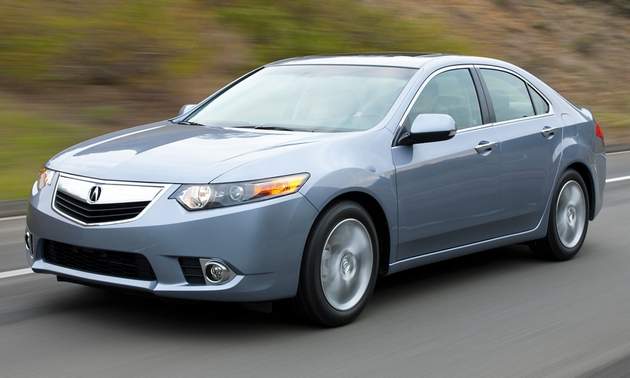
This 2011 Acura TSX Tech is Exhibit A on how small-displacement engines can still add up to a lot of fun. The 2.4-liter four-banger under the hood makes just 201 hp, but because of a terrific short-throw six-speed manual, a great chassis with a (sometimes overly) firm suspension and direct steering, you maximize every last pony at your disposal. Really, if I could change one thing about this car, it would be to have that great powerplant drive the rear wheels instead of the front ones.

The overall balance of this Acura is terrific, and the handling is as good as any front-driver on the market. This is a fun car to grab a lower gear, toss into a corner and put the power down, look for the exit and then hopefully, another corner just around the bend. This is one of those cars that rewards aggressive driving, letting you know at all times exactly where you are at on the road.

Combine all of these great handling attributes with what is arguably one of the best sound systems on wheels, and you have a rather compelling overall package. As a daily driver, you could certainly do a whole lot worse for your $35,000.

You're right, Roger. You could do a whole lot worse for a daily driver. In fact, if I was looking for a daily driver of my own, the Acura TSX would be it. It's no secret that I'm a Honda/Acura fan (though, it's becoming more difficult with each passing year) and I love this K-series engine and six-speed manual drivetrain combination. The shifter is precise and clutch take-up is tuned to my liking in the middle of the pedal stroke.

The 2.4-liter four-cylinder is smooth and revs effortlessly to its 7,000-rpm redline. As is standard procedure with these high-strung Honda engines, you need to keep the revs up to stay in the power and that's something I enjoy doing. This coming from someone who autocrossed my brother's Integra Type R (8,400-rpm redline) a lot before and currently has a S2000 CR (8,000-rpm redline) in the garage.

Besides the drivetrain, the chassis tuning is also something I like a lot. The steering is hypersensitive and will catch people by surprise in the beginning, but you get acclimated to it easily and will end up enjoying it when placing the car wherever you want, whenever you want is so easy. The suspension is stiffer, while not punishing you during normal commutes. The overall result is a car that feels eager and light on its feet even weighing in at 3,400 pounds.

As much as I like this car, I'm not under the illusion that the blade/beak front grille looks good. I will say that the TSX is probably the best integration of the hideous front end, though. The rest of the exterior is clean and sharp-looking with the subtle wheel arches.

Inside, the cabin is great with supportive and comfortable front bucket seats. It's easy to find a good seating position, and the minefield of buttons on the center stack to control radio/climate/navigation functions is overwhelming at first glance but is easily picked up. Would you rather have an iDrive-like system, a touch screen or a bunch of buttons? I'll take buttons every time.

On our Technology package model, the ELS audio system sounds great and is one of my favorite setups. The navigation system is also intuitive, and the rearview camera projects a nice, clear image on the center screen.

My best piece of advice to those shopping a TSX is to resist going with the more powerful V6 model and get the four-cylinder with the six-speed manual. However, if you want the technology stuff with that drivetrain, you best run to the dealership now to find a leftover 2011 model. Acura won't be offering the Technology package with the I4 and manual for 2012, which I think is a shame. Instead, it will only be offered on the more performance-oriented Special Edition models, which I do look forward to driving.

2011 Acura TSX Tech

Base Price: $35,595

As-Tested Price: $35,595

Drivetrain: 2.4-liter I4; FWD, six-speed manual

Output: 201 hp @ 7,000 rpm, 172 lb-ft @ 4,300 rpm

Curb Weight: 3,400 lb

Fuel Economy (EPA/AW): 24/24.1 mpg

2012 BMW 128i Coupe


I can't wait to drive the 1-series M coupe after streaking around town in this 2012 BMW 128i. The tight chassis, weighted, responsive steering and athletic demeanor all are good signs for the performance version.

Still, this entry model is plenty stout. I love the six-speed manual, which takes what could be a potentially boring little car and enlivens its spirit and that of the driver. The shifting is smooth, easy and eager. It makes the pilot want to nail the throws and feel the interaction. I didn't really drive this thing hard, but it feels like it needs some hard cornering and intense maneuvers to really be at its best.

The straight six is reasonably powerful for this application, and merging on to the freeway is easy and brisk if the driver wants to move with verve. The brakes return a solid bite, and the body is quite composed. I like the looks and subtle curves evident in the doors. It's a sharp execution for the segment.

My only quibble is the price. I realize this is still a luxury-level BMW, but it seemed a little Spartan and the price a touch steep with a sticker of more than $36,000. Small cars can be premium and luxurious--no argument there. It just seems like this car commands its sticker because it has three certain letters on the badge. I feel as if I've been in Hyundais and Fords that cost less and have more extras.

Still, the 128i is a hoot to drive for enthusiast motorists.

The 1-series is certainly a fun and entertaining package. The car is Exhibit A in how a small coupe should handle and behave. The six-cylinder is strong and willing, meshed with a terrific six-speed gearbox with nice short throws.

Greg sort of hit nail on the head in that the interior does have a rather Spartan feel, harking back to German cars from 20 or 30 years ago. Obviously it's more updated than that, but manual seats in a $36,000 car? I think not. No satellite radio in a $36,000 car? Really?

No question this is a fun, more than competent car that engages the driver during every mile driven. But for this price, you can find less expensive cars that deliver just as much fun in a more comfortable package.

Both Greg and Roger hit on the fundamental problem with the BMW 1-series: It's too expensive. Knowing it had that reputation, I deliberately didn't check the sticker or our as-tested price before I spent an evening in the car, since I wanted to evaluate based on its driving merits. And there are a lot of them.

The 128i drives like an E36 3-series, and that's a high compliment in my book. The engine makes all the right sounds, and the shifter feels directly connected to the torquey powertrain as God intended. Steering is well weighted and direct, and the brakes are BMW-good. The 128i offers an engaging, visceral driving experience that's been engineered out of most new cars, including those built by BMW.

The problem is, the 128i is also equipped like an E36 3-series. The infotainment system is mediocre at best, the interior plastics are chintzy in some places and there's little to break up the design elements. Note that I don't have a problem with a fun-to-drive car that's lightly equipped. I do have a problem with said car costing $37,000.

I had a blast spending my commute in this 2012 BMW 128i coupe. When I wasn't crawling in accident-riddled rush-hour traffic, I took advantage of the chance to really push this puppy.

This car is a pure pleasure to pilot. Shifting this BMW was a breeze and loads of fun. I felt right in tune with this car, feeling instant responses to my actions with respect to the gearbox, steering and brakes. The impeccable engineering allowed me to focus on the genuine enjoyment of driving, and that is a difficult find these days.

BMW did an excellent job carrying the sporty, strong nature of the 1-series performance to the exterior design. The mildly curved body lines and updated lighting give the 1-series a sleek, athletic yet upscale look. This car is full of energy even while it's parked.

My one gripe concerns the interior. Other than the fact that I expected a better material mixture and composition, it was simply not that intuitive. I found myself having to search for some controls because of hit-and-miss labeling and/or odd placement.

All in all, I was very impressed with the character that this little car churns out. I do agree that a little more needs to be done to reach the sticker-price level, but a few additional features and a touch of interior refinement would easily get it there.

2012 BMW 128i Coupe

Base Price: $31,825

As-Tested Price: $36,125

Drivetrain: 3.0-liter I6; RWD, six-speed manual

Output: 230 hp @ 6,500 rpm, 200 lb-ft @ 2,750 rpm

Curb Weight: 3,208 lb

Fuel Economy (EPA/AW): 22/22.9 mpg

Options: Black Boston leather ($1,450); sport package including 17-inch style 370 with mixed-performance tires, sport seats, sport suspension and shadowline exterior trim ($1,300); titanium silver metallic exterior paint ($550); comfort access keyless entry ($500); heated front seats ($500)

23 Eylül 2011 Cuma

2012 Chevrolet Sonic


First of all, no, it is not built on the same platform nor is it mechanically affiliated with the product formerly known as the Aveo. The all-new Chevrolet Sonic, General Motors' entry in the B-class segment, is the first car to ride on the all-new Gamma, or Global Small Vehicle platform, variations of which you will soon see popping up in markets all over the world. The Sonic is on sale now in U.S. Chevy showrooms.

It comes as a sedan or a hatchback and with either a 138-hp 1.8-liter or 138-hp turbocharged 1.4-liter four driving the front wheels. Yes, they both make 138 hp. The normally aspirated 1.8 makes 125 lb-ft of torque at 3,800 rpm and the turbo makes 148 lb-ft at 1,850 rpm, so the turbo's the one you want. The 1.8-liter comes with a six-speed automatic or a six-speed manual. The turbo comes standard with a six-speed manual but will get a six-speed automatic this spring.

Just remember to order the turbo with the manual.

Early engineering drives in prototypes last May showed a promisingly fun little car. Turns out those analyses were pretty accurate. We spent a day driving several Sonics in the hills above Santa Cruz, Calif., and had a surprisingly good time. Surprising because the Aveo was about as much fun behind the wheel as driving a wet paper bag. Engineers proudly pointed out the Sonic's higher torsional rigidity versus that of the Aveo. Greater use of high- and ultra-high-strength steel gave them a much better basis on which to build. The resonant frequency of the Sonic is 23 hertz, an exponential improvement over the 18-hertz carcass of the Aveo. Forged alloy wheels--yes, forged alloy wheels--tuned bushings and an engine cradle bolted straight to the unibody helped keep the Sonic controlled. A quick 14:1 ratio for the electric power steering further helped.

We got to drive competitors such as the Ford Fiesta (another great chassis but with a softer automatic transmission and more kickback than a Chicago alderman), the Honda Fit (another soft automatic trans but another good chassis) and the Hyundai Accent (GDI for $15,000? Yahoo!). The Sonic came across as having the best ride isolation and as being the quietest of the bunch while not sacrificing any of the tossability inherent in small cars such as this.


It's a buyer's market in the B-class segment. You almost can't go wrong. The Sonic starts at $14,995 including destination and 10--count 'em--10 airbags. A five-door turbo with a sunroof is about the most you can spend on one of these, and it's about $19,500. Chevy builds these in Lake Orion, Mich., too, unlike the competition, all of which, Chevy points out, are built outside the United States.